Pages

Sunday, January 9, 2011

Uttar Pradesh B.Ed. Joint Entrance Exam. 2010

General Knowledge

1. How many schedules the Constitution of India contains ?
(A) 9
(B) 10
(C) 11
(D) 12
Ans : (D)

2. The Constitution of India was adopted in—
(A) 26 January, 1950
(B) 26 January, 1949
(C) 26 November, 1949
(D) 31 December, 1949
Ans : (C)

3. In a nuclear reactor, one of the following is used as a fuel—
(A) Coal
(B) Uranium
(C) Radium
(D) Diesel
Ans : (B)


4. The first muslim ruler to introduce the system of price control was—
(A) Balban
(B) Jalaluddin Khalji
(C) Muhammad-bin-Tughlaq
(D) Alauddin Khalji
Ans : (D)

5. Tansen, a great musician, was in the court of—
(A) Akbar
(B) Bahadur Shah
(C) Rana Kumbha
(D) Krishna Deva Rai
Ans : (A)

6. Who among the following attended all the three Round Table Conferences ?
(A) Jawaharlal Nehru
(B) Dr. B. R. Ambedkar
(C) Vallabh Bhai Patel
(D) Dr. Rajendra Prasad
Ans : (B)

7. Where is National Sugar Institute established?
(A) Kanpur
(B) New Delhi
(C) Lucknow
(D) Gajrola
Ans : (A)

8. A national leader, whose birthday is observed as the National Education Day on November 11, is—
(A) J. B. Kriplani
(B) Rajiv Gandhi
(C) Maulana Abul Kalam Azad
(D) Sarojini Naidu
Ans : (C)

9. The Nagarjuna Sagar Project is constructed on the river—
(A) Kaveri
(B) Krishna
(C) Godavari
(D) Indus
Ans : (B)

10. The Bermuada Triangle lies in—
(A) Western North Atlantic Ocean
(B) Eastern South Atlantic Ocean
(C) North Pacific Ocean
(D) South Indian Ocean
Ans : (A)

11. Who among the following has been honoured with Bharat Ratna for the year 2008 ?
(A) Dr. A. P. J. Abdul Kalam
(B) G. Madhavan Nair
(C) Pt. Bhimsen Joshi
(D) Lata Mangeshkar
Ans : (C)

12. Which of the following is India’s first nuclear powered submarine launched on 26 July, 2009 ?
(A) INS Virat
(B) INS Arihant
(C) INS Vikrant
(D) INS Talwar
Ans : (B)

13. The speed of light will be minimum while passing through—
(A) Glass
(B) Vacuum
(C) Water
(D) Air
Ans : (A)

14. Galvanised iron sheets have a coating of—
(A) Tin
(B) Lead
(C) Zinc
(D) Chromium
Ans : (C)

15. I.B.R.D. is also known as—
(A) International Bank
(B) World Bank
(C) Asian Development Bank
(D) Bank of America
Ans : (B)

16. The Gupta king who assumed the title of Vikramaditya was—
(A) Skandagupta
(B) Samudragupta
(C) Chandragupta–II
(D) Kumaragupta
Ans : (C)

17. Part IV of the Constitution of India deals with—
(A) Fundamental Rights
(B) Citizenship
(C) Directive Principles of State Policy
(D) Union Executive
Ans : (C)

18. Which amidst the following countries of the European union has not adopted the single currency Euro ?
(A) France
(B) U. K.
(C) Germany
(D) Spain
Ans : (B)

19. Permanent members of U. N. Security Council are—
(A) U.K., U.S.A., Russia, China, Japan
(B) U.S.A., France, China, U.K., Canada
(C) U.S.A., France, U.K., Russia, Canada
(D) U.S.A., U.K., France, Russia, China
Ans : (D)

20. The author of the book ‘My Country My Life’ is—
(A) Lal Krishna Advani
(B) Jaswant Singh
(C) Dilip Kumar
(D) Sunil Gavaskar
Ans : (A)

21. The Partition of Bengal was revoked by the British Government in the year—
(A) 1907
(B) 1917
(C) 1911
(D) 1921
Ans : (C)

22. The first talkie film in India was—
(A) Raja Harish Chandra
(B) Alam Ara
(C) Chandi Das
(D) Jhansi Ki Rani
Ans : (B)

23. ‘Blue Revolution’ is related to—
(A) Space research
(B) Irrigation
(C) Fisheries
(D) Drinking water
Ans : (C)

24. India has the maximum foreign trade with—
(A) Japan
(B) Germany
(C) U.S.A.
(D) U.K.
Ans : (C)

25. The most urbanised country in the world is—
(A) Japan
(B) Singapore
(C) Germany
(D) Israel
Ans : (B)

26. Which is the highest finance body for small scale industries ?
(A) IDBI
(B) SIDBI
(C) IFCI
(D) NABARD
Ans : (B)

27. What is the new name of the old region ‘Siam’ ?
(A) Myanmar
(B) Thailand
(C) Philippines
(D) Cambodia
Ans : (B)

28. Great poet Amir Khusarau’s birth place was—
(A) Patiyali (Etah)
(B) Kanpur
(C) Tehran
(D) Lahore
Ans : (A)

29. Bauxite is an ore of one of the following metals—
(A) Aluminium
(B) Silver
(C) Tin
(D) Steel
Ans : (A)

30. Who organized the fourth Buddhist council ?
(A) Ashoka
(B) Harsha
(C) Bindusara
(D) Kanishka
Ans : (D)

31. Who was the last ruler of Lodi dynasty ?
(A) Bahlol Lodi
(B) Ibrahim Lodi
(C) Sikandar Lodi
(D) Daulat Khan Lodi
Ans : (B)

32. The Capital of Andaman and Nicobar islands is—
(A) Port Blair
(B) Diu
(C) Kolkata
(D) Tirupati
Ans : (A)

33. Who among the following decides if a particular Bill is a Money Bill or not ?
(A) President
(B) Speaker of Lok Sabha
(C) Chairman of Rajya Sabha
(D) Finance Minister
Ans : (B)

34. ‘Bar’ is the unit of—
(A) Heat
(B) Temperature
(C) Current
(D) Atmospheric pressure
Ans : (D)

35. Right to vote is a—
(A) Political right
(B) Civil right
(C) Economic right
(D) Legal right
Ans : (A)

36. Koneru Humpy is associated with—
(A) Lawn Tennis
(B) Hockey
(C) Chess
(D) Badminton
Ans : (C)

37. Which of the following hills connect eastern and western ghats ?
(A) Satpura
(B) Vindhya
(C) Nilgiri
(D) Aravalli
Ans : (C)

38. Which country is known as the ‘Cockpit of Europe’ ?
(A) Belzium
(B) Switzerland
(C) Netherlands
(D) Luxembourg
Ans : (A)

39. In Uttar Pradesh, Charkula folk dance is related with—
(A) Ruhelkhand region
(B) Brij region
(C) Bundelkhand region
(D) Avadh region
Ans : (B)

40. Which among the following is a central university in Uttar Pradesh ?
(A) Dr. Ram Manohar Lohia Avadh University, Faizabad
(B) Mahatma Gandhi Kashi Vidyapeeth, Varanasi
(C) Chhatrapati Sahuji Maharaj University, Kanpur
(D) Allahabad University, Allahabad
Ans : (D)

41. Lucknow Congress session 1916, was presided over by—
(A) Sarojini Naidu
(B) Maulana Abul Kalam Azad
(C) Ambika Charan Majumdar
(D) Pt. J. L. Nehru
Ans : (C)

42. Rihand Project is located at—
(A) Lalitpur district
(B) Mirzapur district
(C) Aligarh district
(D) Sultanpur district
Ans : (B)

43. Where was ‘Tanchoi’ brocade developed ?
(A) Varanasi
(B) Dhaka
(C) Surat
(D) Tanjavur
Ans : (A)

44. Who wrote ‘Sarfaroshi Ki Tamanna Ab Hamare Dil Mein Hai’ ?
(A) Mohammed Iqbal
(B) Kazi Nazrul Islam
(C) Anand Narayan Mulla
(D) Ram Prasad Bismil
Ans : (D)

45. The chemical that is used in making artificial rain is—
(A) Silver Nitrate
(B) Silver Iodide
(C) Silver Nitrite
(D) Silver Chloride
Ans : (B)

46. Which of the following is the hardest substance in the human body ?
(A) Bone
(B) Enamel
(C) Nail
(D) None of these
Ans : (B)

47. Agricultural income tax is a source of revenue to—
(A) Central Government
(B) State Government
(C) Local Administration
(D) Centre and State Governments
Ans : (B)

48. Largest Mica deposits are in—
(A) South Africa
(B) Australia
(C) Canada
(D) India
Ans : (D)

49. Lalitpur district in U. P. is known for the—
(A) Uranium deposits
(B) Sugar industry
(C) Polic training academy
(D) None of these
Ans : (A)

50. Which of the following oceans has the shape of the English alphabet ‘S’ ?
(A) Arctic Ocean
(B) Indian Ocean
(C) Atlantic Ocean
(D) Pacific Ocean
Ans : (C)


English Language

Directions—(Q. 51–55) In these questions, sentences are given with blanks to be filled in with an appropriate words four alternatives are suggested for each question. Choose the correct alternative out of the four and indicate the correct sequence.

51. Tourists always enjoyed .................... the setting sun in the Darjeeling hills.
(A) to watch
(B) watching
(C) in seeing
(D) seeing
Ans : (B)

52. The speaker did not properly space out his speech, but went on .......... one point only.
(A) stressing
(B) avoiding
(C) devoting
(D) decrying
Ans : (A)

53. A ............... of Japanese artists stepped off the coach amidst a warm welcome.
(A) troop
(B) troupe
(C) band
(D) gang
Ans : (B)


54. Today students should be reconciled .............. the way things are changing.
(A) with
(B) to
(C) for
(D) at
Ans : (A)

55. Ramappa ........... as the Mayor of the town and he will assume charge this Friday.
(A) elects
(B) elected
(C) is elected
(D) is electing
Ans : (C)

Directions—(Q. 56—60) In these questions, some of the sentences have errors and some have none. Find out which part of a sentence has an error and indicate corresponding to the appropriate letter (A, B, C). If there is no error, indicate corresponding to (D).

56. He ate (A) / nothing (B) / since yesterday. (C) No error (D)
Ans : (A)

57. An experimental vaccine (A) / has brought (B) / glimmer of hope for malarial researcher. (C) No error (D)
Ans : (C)

58. After making me wait for two agonising hours (A) / the great man called me in (B) / and asked me what do I want. (C) No error (D)
Ans : (A)

59. The ebb and flow of the tides (A) / are (B) / now understood. (C) No error (D)
Ans : (B)

60. The green paint on the wall (A) / provides a suitable contrast (B) / with the yellow doors. (C) No error (D)
Ans : (C)

Directions—(Q. 61–65) Group of four words are given. In each group one word is wrongly spelt. Find the wrongly spelt word.
61. (A) Submitted
(B) Admitted
(C) Comitted
(D) Omitted
Ans : (C)

62. (A) Brillient
(B) Valiant
(C) Salient
(D) Radiant
Ans : (A)

63. (A) Recuperate
(B) Regulate
(C) Reinstate
(D) Seperate
Ans : (D)

64. (A) Cease
(B) Seize
(C) Beseige
(D) Beseech
Ans : (C)

65. (A) Carrier
(B) Carreer
(C) Courier
(D) Barrier
Ans : (B)

Directions—(Q. 66–70) Out of the four alternatives, choose the one which best expresses the meaning of the given word and indicate the answer.

66. Censure
(A) Criticise
(B) Appreciate
(C) Blame
(D) Abuse
Ans : (A)

67. Diligent
(A) Industrious
(B) Indifferent
(C) Intelligent
(D) Energetic
Ans : (A)

68. Contemplation
(A) Consideration
(B) Meditation
(C) Deliberation
(D) Speculation
Ans : (B)

69. Adulation
(A) Duration
(B) Argument
(C) Flattery
(D) Institution
Ans : (C)

70. Quiver
(A) Quarrel
(B) Quicken
(C) Waver
(D) Tremble
Ans : (D)

Directions—(Q. 71–75) Choose the word opposite in meaning to the given word and choose the correct alternative.

71. ANIMOSITY
(A) Love
(B) Lust
(C) Luck
(D) Loss
Ans : (A)

72. ALTERCATION
(A) Explanation
(B) Challenge
(C) Compromise
(D) Opposition
Ans : (C)

73. COAX
(A) Dull
(B) Dissuade
(C) Active
(D) Speed
Ans : (B)

74. ERUDITE
(A) Educated
(B) Unscholarly
(C) Scholarly
(D) Possessive
Ans : (B)

75. AFFLUENT
(A) High
(B) Poor
(C) Rare
(D) Fluent
Ans : (B)

Directions—(Q. 76–80) In these questions, four alternatives are given for the idiom/phrase bold in the sentence. Choose the alternative which best expresses the meaning of the idiom/phrase and indicate the correct answer.

76. A few days before his death, he made a clean breast of everything.
(A) Confessed
(B) Took off his shirt
(C) Suffered
(D) Spoke ill
Ans : (A)

77. I am done for.
(A) Ruined
(B) Rewarded
(C) Answered
(D) Questioned
Ans : (A)

78. For a healthy and lasting friendship one must be on the level.
(A) Equally rich
(B) Mentally compatible
(C) Honest and sincere
(D) Ready for sacrifices
Ans : (A)

79. The foolish young man soon made ducks and drakes of the vast property his father left him.
(A) Squandered
(B) Distributed
(C) Spent
(D) Gave in charity
Ans : (A)

80. All his ventures went to the winds.
(A) Dissipated
(B) Spread all over
(C) Got speed of the winds
(D) Became well-known
Ans : (A)

Directions—(Q. 81–90) In these questions, some of the words have been left out. First read the passage over and try to understand what it is about. Then fill in the blanks with the help of the alternatives given. Indicate your correct answer—

Passage
Happy is the man who …(81)… the habit of reading when he is young. He has secured a lifelong source of …(82)…, instruction and inspiration. So long as he has his beloved books he need …(83)… feel lonely. He always has a pleasant …(84)… of leisure moments. He is the …(85)… of wealth more precious than gold. …(86)… indeed is the man who does not read and …(87)… is his life. …(88)… gives the highest kind of pleasure. When we are …(89)… it is a healthy recreation to lose …(90)… in the company of books.

81. (A) owns
(B) buys
(C) acquires
(D) takes
Ans : (C)

82. (A) pleasure
(B) satisfaction
(C) sadness
(D) dejection
Ans : (A)

83. (A) always
(B) ever
(C) sometimes
(D) never
Ans : (D)

84. (A) source
(B) occupation
(C) possession
(D) relief
Ans : (A)

85. (A) possessor
(B) loser
(C) master
(D) heir
Ans : (A)

86. (A) rich
(B) lucky
(C) poor
(D) bad
Ans : (C)

87. (A) full
(B) vacuum
(C) empty
(D) deep
Ans : (C)

88. (A) writing
(B) speaking
(C) listening
(D) reading
Ans : (D)

89. (A) weak
(B) fresh
(C) sick
(D) tired
Ans : (C)

90. (A) himself
(B) ourselves
(C) yourselves
(D) themselves
Ans : (B)

Directions—(Q. 91–95) In these questions, you have one brief passage with 5 questions following the passage. Read the passage carefully and choose the best answer-each question out of the four alternatives and indicate the correct answer.

Passage
The public sector banks are witnessing in India a period of transition and are at crossroads, where they without giving up social responsibility, should also remain healthy. They need to undertake risky experiments. yet perform it innovatively in a way it does not fail. They should make forays into new areas which are rarely tread by them and lose no emerging opportunities. It should be understood that absence of any bad advance is no sign of efficient banking system. It only indicates immense. conservatism. However this is no guarantee for profit. There should be a balance between liquidity and risk. Past sins should be forgotten. Novel and pragmatic techniques should be adopted without which banks would be in danger.

91. What according to the author, are the public sector banks witnessing ?
(A) A period of profit
(B) A period of change
(C) A period of certainty
(D) A loss-making period
Ans : (B)

92. In addition to being socially responsible, what does the author want the banks to be ?
(A) Customer-friendly
(B) Able to attract foreign investors
(C) Financially healthy
(D) Senseless risk-takers
Ans : (C)

93. How can the banks take risks without risking a failure ?
(A) By being innovative
(B) By soliciting the help of the government
(C) By being financially healthy
(D) By being conservative
Ans : (A)

94. What does the absence of any bad advance indicate ?
(A) A penchant for risks
(B) Immense conservatism
(C) Financial independence
(D) A deep-seated social commitment
Ans : (D)

95. What would happen if novel and pragmatic techniques are ignored ?
(A) Will put the banks in danger
(B) Will undermine the banks’ social commitment
(C) Will reveal the untapped talent
(D) Will result in inefficient portfolio management
Ans : (A)

Directions—(Q. 96–100) In these questions, out of the four alternatives, choose the one which can be substituted for the given words/sentence and indicate the appropriate answer.

96. Simple, fast-spreading plant without flowers or leaves, which can often cause disease—
(A) Bacteria
(B) Amoeba
(C) Virus
(D) Fungus
Ans : (A)

97. One who is greedy—
(A) Voracious
(B) Avaricious
(C) Carnivorous
(D) Omnivorous
Ans : (B)

98. An area of land that is controlled by a ruler—
(A) Colony
(B) Dominion
(C) County
(D) Municipality
Ans : (B)

99. A place where Jews worship according to their religion—
(A) Cathedral
(B) Synagogue
(C) Chapel
(D) Demagogue
Ans : (B)

100. One who is indifferent to pleasure and pain—
(A) Ascetic
(B) Esoteric
(C) Stoic
(D) Sceptical
Ans : (C)


Efficiency Test

Directions—(Q. 1–5) Select the related letter/word/number/figure from the given alternatives.

1. Book : Publisher :: Film : ?
(A) Writer
(B) Editor
(C) Director
(D) Producer
Ans : (D)

2. Menu : Food :: Catalogue : ?
(A) Books
(B) Library
(C) Newspaper
(D) Rack
Ans : (A)

3. FILM : ADGH :: MILK : ?
(A) ADGF
(B) HDGE
(C) HDGF
(D) HEGF
Ans : (C)


4. BJNT : CIOS :: DHPV : ?
(A) EGQU
(B) EIQW
(C) ELPV
(D) EIOU
Ans : (A)

5. KIJM : QOPS :: MKLO : ?
(A) LMOR
(B) OMNS
(C) KMOQ
(D) OMNQ
Ans : (D)

6. If DELHI is coded as 73541 and CALCUTTA as 82589662, how can CALICUT be coded ?
(A) 5279431
(B) 5978213
(C) 8251896
(D) 8543691
Ans : (C)

7. If in a code language PRINCIPAL is written as MBOQSOMVW and TEACHER is written as FDVSZDB, how is CAPITAL written in that code ?
(A) SVMOFVW
(B) SVMODVW
(C) BVMODVW
(D) SVMIDVW
Ans : (A)

8. A statement followed by two assumptions I and II is given. You have to consider the statement to be true even if it seems to be at variance from commonly known facts. You are to decide which of the given assumptions can definitely be drawn from the given statement. Indicate which one of the four given alternatives is correct ?
Statement : If more encouragement is given to Sports, Indians will win more gold medals at the Olympic Games.
Assumptions : I. Indians do not win gold medals.
II. More encouragement in Sports leads to better performance.
(A) Only I is valid
(B) Only II is valid
(C) Both assumptions are valid
(D) Both assumptions are invalid
Ans : (B)

9. Two statements are given followed by two conclusions I and II. You have to consider the two statements to be true even if they seem to be at variance from commonly known facts. You have to decide which one of the given conclusions is definitely drawn from the given statements.
Statement : All virtuous persons are happy.
No unhappy person is virtuous.
Conclusions : I. Happiness is related to virtue
II. Unhappy person is not virtuous.
(A) Only I follows
(B) Only II follows
(C) Neither I nor II follows
(D) Both I and II follow
Ans : (D)

10. Rahim travelled straight from point E to F at a distance of 5 km. From F he turned left and travelled 6 km and reached point G, there he took a left turn and travelled 5 km to reach point H. He took another left turn and travelled 2 km and reached point I. How far is he from the starting point ?
(A) 3 km
(B) 4 km
(C) 5 km
(D) 7 km
Ans : (B)

11. A man is facing East, then the turns left and goes 10 m, then turns right and goes 5 m, then goes 5 m to the South and from there 5 m to West. In which direction is he, from his original place ?
(A) East
(B) West
(C) North
(D) South
Ans : (C)

Directions—(Q. 12–17) Find the odd word/letters/number/figure from the given responses.

12. (A) Newspaper
(B) Press
(C) Edition
(D) Audition
Ans : (D)

13. (A) Microbe
(B) Microfilm
(C) Microphone
(D) Microscope
Ans : (A)

14. (A) PRSQ
(B) UWXV
(C) LONM
(D) CEFD
Ans : (C)

15. (A) YXVU
(B) ORQP
(C) KJHG
(D) MLJI
Ans : (B)

16. (A) 43
(B) 53
(C) 63
(D) 73
Ans : (C)

17. (A) 21, 42
(B) 24, 48
(C) 37, 74
(D) 35, 28
Ans : (D)

18. In a coding system PEN is written as NZO and BARK as CTSL. How can we write PRANK in that coding system ?
(A) NZTOL
(B) CSTZN
(C) NSTOL
(D) NTSLO
Ans : (C)

19. If BROTHER is coded as 2456784 SISTER is coded as 919684, What is the code for ROBBERS … ? …
(A) 18, 15, 22, 5, 18, 19
(B) 4562, 684
(C) 9245, 784
(D) 4522849
Ans : (D)

20. A word given in Capital Letters is followed by four answer words. Out of these only one can be formed by using the letters of the given words. Find out that word—
ENVIRONMENT
(A) EMINENT
(B) ENTRANCE
(C) ENTERTAIN
(D) MOVEMENT
Ans : (A)

21. A word is given in capital letters. It is followed by four words. Out of these four words, three cannot be formed from the letters of the word in capital letters. Point out the word which can be formed from the letters of the given word in capital letters—
ARCHITECTURE
(A) LECTURE
(B) UREA
(C) CHILDREN
(D) TENT
Ans : (B)

22. A word given in capital letters is followed by four words. Out of these only one cannot be formed by using the letters of the given word. Find out that word—
REVOLUTIONARY
(A) REVOLT
(B) TRAIL
(C) VOCATION
(D) VOLUNTARY
Ans : (C)

23. Giridharlal’s family consists of his wife Radha. 3 sons and 2 daughters. One daughter is yet to be married and the other daughter has a son. Two sons have 2 children each and the third son has 3 children. An old aunt and sonin-law also stay with them. How many members are there in Giridharlal’s family ?
(A) 20
(B) 19
(C) 18
(D) 17
Ans : (A)

24. A family went out for a walk. Daughter walked before the father. Son was walking behind the mother and ahead of father. Who walked last ?
(A) Son
(B) Father
(C) Mother
(D) Daughter
Ans : (B)

25. Seema is the daughter-in-law of Sudhir and sister-in-law of Ramesh. Mohan is the son of Sudhir and only brother of Ramesh. Find the relation between Seema and Mohan—
(A) Sister-in-law
(B) Aunt
(C) Cousin
(D) Wife
Ans : (D)

Directions—(Q. 26–32) Select the related letters/word/number/figure from the given alternatives—

26. Orange : Peel : : Nut : … ? …
(A) Pulp
(B) Shell
(C) Kernel
(D) Rind
Ans : (B)

27. Foundation : Edifice : : Constitution : … ? …
(A) Government
(B) State
(C) Nation
(D) Cabinet
Ans : (A)

28. Plat : Botany : : Man : … ? …
(A) Ecology
(B) Psychology
(C) Anthropology
(D) Sociology
Ans : (C)

29. GIKM : TRPN : : JLNP : … ? …
(A) QOMN
(B) WUSQ
(C) PRTV
(D) TVXZ
Ans : (B)

30. ACAZX : DFDWU : : GIGTR : … ? …
(A) JKJQO
(B) JLJQO
(C) JKJOQ
(D) JLJOP
Ans : (B)

31. 63 : 80 : : 120 : … ? …
(A) 125
(B) 143
(C) 170
(D) 180
Ans : (B)

32. 7 : 49 : 56 : : 14 : 196 : 210 : : … ? …
(A) 9 : 81 : 91
(B) 12 : 140 : 156
(C) 21 : 441 : 462
(D) 21 : 440 : 461
Ans : (C)

Directions—(Q. 33–39) Select the related letters/word/number/figure from the given alternatives—

33. (A) Square
(B) Circle
(C) Rectangle
(D) Triangle
Ans : (B)

34. (A) Temple
(B) Mosque
(C) Theatre
(D) Church
Ans : (C)

35. (A) Sweet
(B) Bitter
(C) Salty
(D) Tasteless
Ans : (D)

36. (A) ZMYL
(B) VIUH
(C) REQD
(D) ANBO
Ans : (D)

37. (A) LJNP
(B) ECGI
(C) CAFG
(D) SQUW
Ans : (C)

38. (A) 16—64
(B) 17—68
(C) 20—100
(D) 21—84
Ans : (C)

39. (A) 63
(B) 126
(C) 215
(D) 342
Ans : (B)

40. Which one of the given responses would be a meaningful order of the following—
1. Seed 2. Flower
3. Soil 4. Plant
5. Fruit
(A) 4, 2, 5, 1, 3
(B) 2, 5, 4, 1, 3
(C) 3, 2, 1, 5, 4
(D) 3, 1, 4, 2, 5
Ans : (D)

41. Arrange the following words according to the dictionary—
1. Scenery 2. Science
3. Scandal 4. School
5. Scatter
(A) 3, 5, 1, 4, 2
(B) 3, 5, 4, 1, 2
(C) 5, 3, 4, 2, 1
(D) 5, 3, 2, 1, 4
Ans : (A)

42. A statement followed by two assumptions I and II is given. You have to consider the statement to be true even if it seems to be at variance from commonly known facts. You are to decide which of the given assumptions are implicit in the given statement. Indicate which one of the four given alternatives is correct ?
Statement : All children like icecream and some children like chocolates.
Assumptions : I. Children who like chocolates also like icecream.
II. Pinky does not like
chocolates but she likes ice-cream.
(A) Only assumption I is implicit
(B) Only assumption II is implicit
(C) Both assumptions I and II are is implicit
(D) Neither assumption I nor II is implicit
Ans : (C)

Directions—(Q. 43–44) If you start running from a point towards. North and after covering 4 km you turn to your left and run 5 km, and then again turn to your left and run 5 km, and then turn to your left again and run another 6 km, and before finishing you take another left turn and run I km, then answer questions 43 and 44 based on this information—

43. How many km are you from the place you started ?
(A) 1 km
(B) 2 km
(C) 3 km
(D) 4 km
Ans : (A)

44. In which direction will you be moving while finishing ?
(A) East
(B) West
(C) North
(D) South
Ans : (C)

45. In a certain code the following numbers are coded in a certain way by assigning sings—
1 2 3 4 5 6 7 8 9
∠∠⊄+⊇∨÷.-
Which number can be decoded from the following ?
∨∠-⊄⊇
(A) 62953
(B) 62935
(C) 62593
(D) 62539
Ans : (B)

46. If UNITY is written as FMRGB in a certain code, how would TRANQUIL be written using the same code ?
(A) GIZMJFRO
(B) TZMFJROM
(C) MJROIZBS
(D) GMPFZROI
Ans : (A)

47. A word given in capital letters is followed by four words. Out of these only one cannot be formed by using the letters of the given word. Find out that word—
EXEMPLIFICATION
(A) FIXATION
(B) EXAMPLE
(C) AXE
(D) EXTRA
Ans : (D)

48. A word is given in capital letters. It is followed by four words. Out of these four words, three cannot be formed from the letters of the word in capital letters. Point out the word which can be formed from the letters of the given word in capital letters—
COMMISSION
(A) OSMOSIS
(B) CONICS
(C) MOAN
(D) COMMON
Ans : (D)

49. In a cricket match, five batsman, A, B, C, D and E scored an average of 36 runs. D scored five more than E; E scored 8 fewer than A; B scored as many as D and E combined; and B and C scored 107 between them. How many runs did E score ?
(A) 62
(B) 45
(C) 28
(D) 20
Ans : (D)

50. The average age of 50 students of a class is 16 years. When 10 new students are admitted, then the average age increased by 0.5 years. The average age of the new students is—
(A) 17 years
(B) 18 years
(C) 19 years
(D) 20 years
Ans : (C)

51. Which of the following is not instructional material ?
(A) Over Head Projector
(B) Audio Casset
(C) Printed Material
(D) Transparency
Ans : (A)

52. Which of the following statement is not correct ?
(A) Lecture Method can develop reasoning
(B) Lecture Method can develop knowledge
(C) Lecture Method is one way process
(D) During Lecture Method students are passive
Ans : (A)

53. Which of the following indicates evaluation ?
(A) Ram got 45 marks out of 200
(B) Mohan got 38 per cent marks in English
(C) Shyam got First Division in final examination
(D) All the above
Ans : (D)

54. Team teaching has the potential to develop—
(A) Competitive spirit
(B) Co-operation
(C) The habit of supplementing the teaching of each other
(D) Highlighting the gaps in each other’s teaching
Ans : (C)

55. Which of the following is the most important characteristic of Open Book Examination system ?
(A) Students become serious
(B) It improves attendance in the classroom
(C) It reduces examination anxiety amongst students
(D) It compels students to think
Ans : (D)

56. Which of the following statements is correct ?
(A) Communicator should have fine senses
(B) Communicator should have tolerance power
(C) Communicator should be soft spoken
(D) Communicator should have good personality
Ans : (A)

57. An effective teacher is one who can—
(A) Control the class
(B) Give more information in less time
(C) Motivate students to learn
(D) Correct the assignments carefully
Ans : (C)

58. The main aim of teaching is—
(A) To develop only reasoning
(B) To develop only thinking
(C) Both (A) and (B)
(D) To give information
Ans : (C)

59. The quality of teaching is reflected—
(A) By the attendance of students in the class
(B) By the pass percentage of students
(C) By the quality of questions asked by students
(D) By the duration of silence maintained in the class
Ans : (C)

60. Another name of Basic Education or Nai Talim is—
(A) Compulsory Education
(B) New Education Policy
(C) Wardha Education Plan
(D) Sarva Shikshya Abhiyan
Ans : (C)

61. If you would be a teacher, how would you like to behave with your students ?
(A) Autocratic
(B) Democratic
(C) Laissezfare
(D) As the conditions permit
Ans : (B)

62. When you are mal-treated in your class as a new comer then how will you deal with the students ?
(A) Through tough punitive measures
(B) Through warning of expulsion
(C) Through improving your qualities
(D) You leave the class
Ans : (C)

63. If students alleged you for making favouritism in evaluation, how can you deal with this problem ?
(A) Giving threat to fail them
(B) Making efforts to reveal the position fairly
(C) Adopting punitive measures
(D) Showing the student’s answer-books in order to satisfy them
Ans : (D)

64. A scheduled caste student is admitted in your class. The other class-mates treat him as untouchable and live in isolation. How would you give him better adjustment in the class ?
(A) By putting examples by his own deeds
(B) By preaching
(C) By showing fear of legal actions
(D) By justifying the plight of downtroddens
Ans : (A)

65. A child has nail-biting habit in the class. How could you improve his habit ?
(A) You leave it because it is not a dangerous disease
(B) You attempt to mould his behaviour under strict observation
(C) You insult him in the class
(D) You make a complaint with his parent
Ans : (B)

66. When a stubborn, submissive and shameful child is sitting in your class, you think about him as he is a—
(A) Good-natured child
(B) Emotionally-disturbed child
(C) Disciplined and obedient child
(D) Serious and studious child
Ans : (C)

67. Teachers need to study educational philosophy mainly, because—
(A) Few, if any, teachers have a philosophy
(B) Most teachers follow a wrong philosophy
(C) Teacher’s are incapable of formulating their own philosophy
(D) Most teacher’s do not know anything about educational philosophy
Ans : (C)

68. Dewey liked best, the following definition of education—
(A) Education as a product
(B) Recapitulation
(C) Acquisition of knowledge
(D) Preparation for life
Ans : (B)

69. Which of the following is not one of the aims and purposes of UNESCO ?
(A) Held an educational isolationism
(B) Promote intellectual interdependence
(C) Helps to unite peoples of the world
(D) Promote pride in nationalistic groups
Ans : (C)

70. UNESCO has as one of its many promising activities, a campaign to provide—
(A) Education for all adults of the member nations
(B) Universal, free, compulsory primary education
(C) Free education to those who desires it
(D) Indoctrination against the dangers of communism
Ans : (A)

71. Suppose a child has hearing impairment but you have no idea about him. What will be your duty towards the child ?
(A) Recognise the child and manage accordingly
(B) You become neutral because it is not your headache
(C) You send him to specialist for treatment
(D) You report to teachers, parents and principal to send him to a special school
Ans : (A)

72. A student belongs to a very poor family. The student, therefore is unable to pay tuition fee for private coaching but he is eager to get some of his problems solved. What provision will you make for the student ?
(A) Give extra time to him
(B) Refuse to solve his problems as you have no spare time
(C) Creating a terror in him
(D) Not giving the ears to his request
Ans : (A)

73. If an orthopaedically handicapped girl student is studying in your class whose right hand is amputed from elbow, how would you encourage her for study ?
(A) You silently laugh at her
(B) You develop her self-confidence and high morale
(C) You treat her as a cruel creation of God
(D) You behave gently and sympathetically
Ans : (B)

74. When your student in bitten by a stray dog on games field, you do—
(A) Inform his parents and impart first-aid immediately
(B) Washing the wound with clean water and leave it open
(C) Ask financial help from school for rabies vaccination
(D) Giving personal assistance in his treatment
Ans : (C)

75. If a student wants to satisfy some querry in question-paper then—
(A) You will clarify the printing mistake
(B) You will inform the concerned subject’s teacher
(C) You will advise him to wait till the correction is being confirmed
(D) Furiously tell him to do as he understands
Ans : (A)

76. It is easier to predict ................ on the basis of aptitude testing than success in an occupation.
(A) Failure
(B) Temperament
(C) Interest
(D) Adjustment
Ans : (A)

77. Frustration for the motives causes—
(A) Inferiority
(B) Anxiety
(C) Inefficiency
(D) Behaviour disorder
Ans : (D)

78. The teacher who has developed an interest in teaching—
(A) Studies problems of student behaviour
(B) Compares different types of tests
(C) Refuses to be guided by the rules of thumb
(D) Cannot deal with children effectively
Ans : (A)

79. The teacher who can apply the principles of Educational Psychology—
(A) Has pride in the teaching profession
(B) Can provide readymade solutions
(C) Adjusts his method to suit the needs of individual children
(D) Compares the theories of learning
Ans : (C)

80. Which of the following is an audio-visual aid ?
(A) Radio
(B) Tape-recorder
(C) Television
(D) Projector
Ans : (C)

81. Motives arouse behaviour and direct it towards an/a—
(A) Appropriate goal
(B) Inference
(C) Prediction
(D) None of the rest
Ans : (A)

82. Learning which involves motor organs is called—
(A) Sensory learning
(B) Motor learning
(C) Verbal learning
(D) Sensory-motor learning
Ans : (B)

83. Find the odd one out—
(A) Recall
(B) Recognition
(C) Trace
(D) Remembering
Ans : (C)

84. The problem child is generally one who has—
(A) An unsolved problem
(B) A poor heredity
(C) A poor home environment
(D) A younger brother or sister
Ans : (A)

85. The First Kindergarten was started by—
(A) Friedrich Froebel
(B) Benjamin Franklin
(C) Johann Pestalozzi
(D) De Witt Clinton
Ans : (A)

86. Rousseau’s major contribution to modern education was the—
(A) Kindergarten
(B) Philanthropy
(C) Use of objects in teaching
(D) Philosophy of Naturalism
Ans : (D)

87. Which of the following is most characteristic of a good teacher ?
(A) He sticks to one activity at a time and completes what he starts before starting something else
(B) He is not afraid of losing dignity when he participates in children’s activities
(C) He puts more do’s than don’ts in his comments to children
(D) He remains objective and impersonal at all times
Ans : (C)

88. A prime requisite for one who enters the teaching profession is—
(A) An IQ of over 125
(B) Public speaking ability
(C) Good health
(D) Extra income
Ans : (C)

89. There is an intimate relationship between the—
(A) Teachers and Educationists
(B) Planned and unplanned School Learning
(C) School and Society
(D) Parents and Children’s Thinking
Ans : (C)

90. Four conditions that must exist in a classroom before any motivational strategies can be successful—
(A) The teacher must be a supportive person
(B) The classroom must be disorganized
(C) The tasks set for students must not be authentic
(D) Constant disruption in class
Ans : (A)

91. The students of today are—
(A) Careless and negligent
(B) Not devoted to studies
(C) Dedicated to studies
(D) Of sharp mind
Ans : (D)

92. Government Policy on Education regards Education a unique—
(A) Consumption
(B) Investment
(C) Source of income
(D) Expenditure
Ans : (B)

93. Motivation is the release of ................ by proceeding towards a goal.
(A) Pride
(B) Tension
(C) Knowledge
(D) Power
Ans : (B)

94. Helping people in the neighbourhood to solve behavioural problems is in the purview of—
(A) Community Psychology
(B) Neighbourhood Psychology
(C) Genetic Psychology
(D) Developmental Psychology
Ans : (A)

95. Nature and Nurture refer to—
(A) Internal and External Environment
(B) Temperament and character
(C) Physical features and temperament
(D) Heredity and Environment
Ans : (D)

96. Acquisition of information and knowledge is—
(A) Ability to learn
(B) Ability to adjust
(C) Ability to memorise
(D) None of the rest
Ans : (A)

97. Motivation should be followed by—
(A) Reward
(B) Reproof
(C) Knowledge of result
(D) Incentive
Ans : (A)

98. The motivated teacher will have following attributes—
(A) Unrealistic level of Aspiration
(B) Goal-directed behaviour
(C) Dissatisfaction
(D) Deprivation of needs
Ans : (B)

99. The teacher should promote—
(A) Anxiety among the students to complete the syllabus in a hurry
(B) Harassing the students for completing the work
(C) Encouraging interactive communication among students
(D) Punishment to a student whenever he puts a question
Ans : (C)

100. Teachers and parents give more importance to the development of intelligence among students as it facilitates—
(A) Academic achievement and social respectability
(B) Less risk taking behaviour
(C) Dependence behaviour
(D) Obedient behaviour
Ans : (A)

Friday, January 7, 2011

JOINT ENTRANCE TEST - AGRI-BUSINESS MANAGEMENT (JET-ABM) - 2011

JET-ABM Test Details
The JET-ABM, 2011 would include the questions in the following areas;
  1. Knowledge of Agriculture will have 40 questions covering the following areas;
  • General Agriculture
  • Agricultural Engineering
  • Animal Husbandry and Veterinary Science
  • Fisheries
  • Food Sciences
  • Forestry
  • Horticulture
  1. Quantitative Aptitude will have 40 questions covering the subjects like statistics and data interpretation
  2. Logical Ability will have 40 questions covering the subjects like reasoning, extrapolation, deduction etc.
  3. Proficiency in English will have 40 questions covering the subjects like reading comprehension, paraphrasing, sentence correction / completion, synonyms and antonyms etc.
  4. General Awareness will have 20 questions from the areas of current affairs, general knowledge and elementary aspects of agri-business.
Duration of JET-ABM, 2011 will be of 2 hours with a total of 180 questions. The right answer will be given one mark and wrong answer will be awarded -1/3 mark.

Tuesday, January 4, 2011

United India Insurance A.A.O. Exam., 2010


General Awareness
(Exam Held on 6-6-2010)
 
1. Jawaharlal Nehru National Solar Mission or Solar India has been launched to create an installed capacity of 2000 MW by the end of—
(A) 13th Plan
(B) 14th Plan
(C) 15th Plan
(D) 16th Plan
Ans : (A)

2. Bollywood actors who, on February 2, 2010 rang bells in NASDAQ on Time Square, New York—an honour usually reserved for CEOs of major corporations, are—
(A) Amir Khan and Priyanka Chopra
(B) Shah Rukh Khan and Kajol
(C) Abhishek Bachchan and Aswarya
(D) Saif Ali Khan and Kareena Kapoor
Ans : (B)

3. The term ‘16 yards hit’ is associated with—
(A) Badminton
(B) Baseball
(C) Polo
(D) Hockey
Ans : (D)

4. The vital constituent of blood that helps in clotting is—
(A) Platelets
(B) Haemoglobin
(C) Plasma
(D) Serum
Ans : (A)

5. Which of the following animals can hear ultrasonic sound ?
(A) Cat
(B) Rat
(C) Bat
(D) Squirrel
Ans : (C)


6. The acid rain destroys vegetations because it contains—
(A) Sulphuric acid
(B) Ozone
(C) Carbon monoxide
(D) Nitric acid
Ans : (A)

7. Man Booker Prize winner Ms. Kiran Desai’s novel, ‘The Inheritance of Loss’ deals with—
(A) Telangana movement
(B) Santhal movement
(C) Gorkhaland movement
(D) Bodoland movement
Ans : (C)

8. GARC is the acronym for—
(A) Global Automotive Research Consortium
(B) Global Atomic Research Consortium
(C) Global Automotive Research Centre
(D) Global Advancement Research Centre
Ans : (C)

9. The largest fresh water lake, ‘Lake Superior’ is located in—
(A) Canada
(B) Russia
(C) Tanzania
(D) Argentina
Ans : (A)

10. In which State of India is the largest river island Majuli ?
(A) Assam
(B) Kolkata
(C) Orissa
(D) M.P.
Ans : (A)

11. Match the following—
(a) Berlin, Germany
(b) Ankara, Turkey
(c) Bristol, UK
(d) Budapest, Hungary
1. Danube
2. Kizil
3. Spree
4. Avon
Codes :
(a) (b) (c) (d)
(A) 2 1 4 3
(B) 4 3 1 2
(C) 1 4 2 3
(D) 3 2 4 1
Ans : (D)

12. Government’s ambitious UID Project has been renamed—
(A) Parichaya
(B) Pahchan
(C) Aadhar
(D) Aanklan
Ans : (C)

13. Who is the author of the book ‘Speaking for Myself’ ?
(A) Salman Rushdie
(B) Cherie Blair
(C) Mohammad Hanif
(D) Hillary Clinton
Ans : (B)

14. The name of India’s first homebuilt stealth warship whose features reduce the probability of being detected at sea is—
(A) Sahyadiri
(B) Satpura
(C) Shivalik
(D) Shivaji
Ans : (C)

15. Which country will host the 17th SAARC summit ?
(A) Bangladesh
(B) Nepal
(C) Shri Lanka
(D) Maldives
Ans : (D)

16. India’s Prime Minister Manmohan Singh is seated at the ……… spot in the leaders’ list of 100 most influential persons of the world realeased by the famous Time Magazine recently.
(A) 15
(B) 19
(C) 23
(D) 27
Ans : (B)

17. The Islam was established in—
(A) 5th A.D.
(B) 7th A.D.
(C) 3rd B.C.
(D) 5th B.C.
Ans : (B)

18. Which part of the human body is highly affected by the nuclear radiation first ?
(A) Bone marrow
(B) Skin
(C) Lungs
(D) Eyes
Ans : (B)

19. Who invented the video-tape ?
(A) Charles Ginsberg
(B) Georges de Mestral
(C) Richard James
(D) P. T. Farnsworth
Ans : (A)

20. Match the following—
(a) NH–1
(b) NH–3
(c) NH–5
(d) NH–7
1. Varanasi–Kanyakumari
2. Kolkata–Chennai
3. New Delhi–Amritsar
4. Agra–Mumbai
Codes :
(a) (b) (c) (d)
(A) 2 1 4 3
(B) 3 4 2 1
(C) 4 3 1 2
(D) 1 3 4 2
Ans : (B)

C-SAT MODEL QUESTION PAPER

Logical Reasoning and Analytical Ability

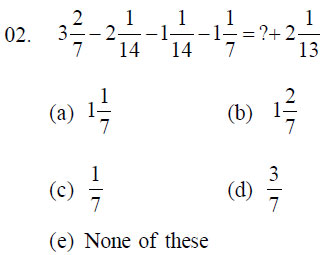
01. How many meaningful English words can be formed with the letters MASTE using each letter only once in each word ?
(a) None
(b) One
(c) Two
(d) Three
(e) More than three
02. Four of the following five are alike in a certain way and so from a group. Which is the one that does not belong to that group ?
(a) 78
(b) 48
(c) 72
(d) 54
(e) 42
03. In a certain code SAFER is written as 5@3#2 and RIDE is written as 2 © %#, how is FEDS written in that code ?
(a) 3#©5
(b) 3@%5
(c) 3#%5
(d) 3#%2
(e) None of these
04. Pointing to a woman. Nirmal said, “she is the daughter of my wife’s grandfather’s only. “How is the woman related to Nirmal ?
(a) Wife
(b) Sister-in-law
(c) Sister
(d) Data inadequate
(e) None of these
05. Four of the following five are alike in a certain way and so from a group. Which is the one that does not belong to that group ?
(a) Sweet
(b) Cake
(c) Pastry
(d) Bread
(e) Biscuit
06. In a certain code CONFUSED is written as EMNBEFTV. How is SECLUDED written in that code ?
(a) RDBKEFEV
(b) KBDRCDCT
(c) KBDREFEV
(d) MDFTCDCT
(e) None of these
07. What should come next in the following letter series ?
Z X V T R P N L J Y W U S Q O

(a) M
(b) K
(c) H
(d) J
(e) None of these
08. How many such digits are there in the number 9254716 each of which is as far away from the beginning of the number as when the digits are rearranged in ascending order?
(a) None
(b) One
(c) Two
(d) Three
(e) More than three
09. In a certain code language, ‘bring the white board’ is written as ‘ka na di pa’ and ‘white and black board’ is written as ‘na di sa ra’. How is ‘the’ written in that code ?
(a) ka
(b) pa
(c) ka or pa
(d) Data inadequate
(e) None of these
10. Among B, F, J, and W, each having a different weight, F is heavier than only J. B is heavier than F and W but not as heavy as K. Who among them is the third heaviest ?
(a) B
(b) F
(c) K
(d) W
(e) None of theses
Directions (Q. 11-16): Study the following arrangement caefully and answer the questions given below:
Y48A@DF3#RNIM©WPJ2E5Z*6QB7$HU9IK
11. Which of the following is the seventh to the right of the nineteenth from the right end of the above arrangement ?
(a) 1
(b) D
(c) Z
(d) $
(e) None of these
12. Four of the following five are alike in a certain way based on based on their positions in above arrangement and so form a group. Which is the one that does not belong to that group ?
(a) D#A
(b) JWE
(c) 562
(d) $9B
(e) RM3
13. How many such consonants are there in the above arrangement each of which is immediate preceded by a symbol and immediately followed by a letter
(a) None
(b) One
(c) Two
(d) Three
(e) More than three
14. How many such number are there in the above arrangemant each of which is immediately preceded by a letter and immediately followed by a symbol ?
(a) None
(b) One
(c) Two
(d) Three
(e) More than three
15. What should come next in the following series based on the above arrangement ?
8@D #NI WSJ 5*6

(a) 7HD
(b) 7$U
(c) 7#9
(d) B$#
(e) None of these
16. If all the numbers are dropped from the above arrangement, which of the following will be the fourteenth from the left end ?
(a) W
(b) P
(c) 8
(d) J
(e) None of these
Directions (Q. 17-22): In each question below are four statements followed by four conclusions numbered I, II III and IV. You have to take the four given statements to be true even if they seem to be at variance with commonly known facts from the four gives statements disregarding commonly known facts. Then decide which of the answers (a), (b), (c), (d), and (e) is correct and indicate it on the answer sheet.
17. Statements : All belts are rollers.
Some rollers are wheels.
All wheels are mats.
Some mats are cars.
Conclusions : I. Some mats are rollers.
II. Some mats are belts.
III. Some cars are rollers.
IV. Some rollers are belts.
(a) Only I and II follow
(b) Only I, II and IV follow
(c) Only I and IV follow
(d) Only II, III and IV follow
(e) None of these
18. Statements : Some tyres are rains.
Some rains are flowers.
All flowers are jungles.
All jungles are tubes.
Conclusions: I. Some jungles are rains
II. Some tubes are rains.
III. Some jungles are rains.
IV. Some tubes are flowers.
(a) Only I, II and III follow
(b) Only II, III and IV follow
(c) Only I, III and IV follow
(d) All follow
(e) None of these
19. Statements : All desks are chirs.
All chiar are tables.
All tables are boxes.
All boxes are trunks.
Conclusions: I. Some trunks are table.
II. All chiars are boxes.
III. Some boxes are desks.
IV. All desks are trunks.
(a) Only I, II and III follow
(b) Only I, II and IV follow
(c) Only II, III and IV follow
(d) All follow
(e) None of these
20. Statements: Some birds are goats.
Some goats are horses.
Some horses are lions.
Some lions are tigers.
Conclusions: I. Some tigers are goats.
II. No tiger is goat.
III. Some lions are birds.
IV. No lion is bird.
(a) Only either I or II follows
(b) Only either III or IV follows
(c) Only either I or II and either III or IV follow
(d) Only I and III follow
(e) None of these
21. Statements: All papers are botteles.
All bottles are cups.
Some cups are jugs.
Some jugs are plates.
Conclusions: I. Some plates are cups.
II. Some plates are bottles.
III. Some cups are papers.
IV. Some bottles are papers.
22. Statements: All papers are bottles.
All bottles are cups.
Some cups are jugs.
Some jugs are plates.
Conclusions: I. Some plates are cups.
II. Some plates are bottles.
III. Some cups are papers.
IV. Some bottles are papers.
(a) Only III and IV follow
(b) Only I and II follow
(c) Only I and III follow
(d) Only II and IV follow
(e) None of these
23. Statements: All bulbs are wires.
No wire is cable.
Some cables are painst
All brushes are painst
Conclusions: I. Some painst are cables.
II. Some wires are bulbs.
III. Some burshes are wires.
IV. Some cables are bulbs.
(a) None follows
(b) Only I & II follow
(c) Only II follow
(d) Only III follow
(e) Only IV follow
Directions (Q. 23-28): In each question below is given a group of letters followed by four combinations ofdigits/symbols numbered (a), (b), (c) and (d). You have to find out which of the combinations correctly represents the group of letters based on the follow and coding system and and conditions that follow and mark the number of that combination as your answer. If none of the combinations correctly represents the group of letters, mark (e) ie ‘None of these’,as your answer.
Letter: R D A E J M K T B U I P W H F
Digit/Symbool Code: 4 8 5 $ * 1 2 6 % © 7 @ 3 #
Conditions:
(i) If the first letter is a consonant and the last letter is a vowel, both are to be coded as $
(ii) If both the first and the last the letters are consonants, both are to be coded as the code for the last letter.
(iii) If the first letter is a vowel and the last letter is a consonant, their codes are to be interchanged.
23. HIFMJU
(a) ©7#1*9
(b) 971*9
(c) ©7#1*©
(d) $ 7#1*$
(e) None of these
24. AKTRBW
(a) 3264%5
(b) 3264%3
(c) 324%65
(d) 5264%3
(e) None of these
25. EBPDRI
(a) 7%@847
(b) 7%@84$
(c) $%8@47
(d) $%8@47
(e) None of these
26. BKAJIM
(a) %25*71
(b) 125*7%
(c) %25*7%
(d) 15*271
(e) None of theses
27. UKPDMA
(a) 52@815
(b) ©2@815
(c) ©2@81©
(d) ©@2815
(e) None of these
28. METUFB
Directions (Q. 29-34): A word and number arrangement machine when given and input line of words and numbers rearranges them following a particular rule in each step. The following is in illustration of input rearrangement.
Input : but 32 71 golory fair south 65 84
Step I : south bout 32 71 glory fair 65 84
Step II : south 84 but 32 71 glory fair 65
Step III : south 84 glory but 32 71 fair 65
Step IV : south 84 glory 71 but 32 fair 65
Step V : south 84 glory 71 fair but 32 65
Step VI : south 84 glory 71 fair 65 bout 32
and step VI is the last step of the rearrangement.
As per the rules followed in the above steps, find out in each of the followed questions the apprepriate step for the given inpt.
29. Step III of an input is: year 92 ultra 15 23 strive house 39 How many more steps will be required to complete the rearrangement?
(a) Three
(b) Four
(c) Two
(d) Five
(e) None of these
30. Input: any how 49 24 far wide 34 69
Which of the following steps will be the last but one?

(a) VI
(b) VII
(c) V
(d) VIII
(e) None of these
31. Step II of an input is: town 74 pair 15 31 nice job 42
Which of the following is definitely the input ?

(a) pair 15 31 town nice job 42 74
(b) pair 15 town 31 74 nice job 42
(c) pair 15 town 74 31 nice job 42
(d) Cannot be determined
(e) None of these
32. Input: play over 49 37 12 match now 81
Which of the following will be step IV ?

(a) play 81 over 49 37 match now
(b) play 81 over 49 37 12 now
(c) play 81 over 49 now 37 match 12
(d) There will be no such step.
(e) None of these
33. Step II of an input is: war 58 box cart 33 49 star Which of the following will be the last ?
(a) V
(b) VI
(c) IV
(d) VII
(e) None of these
34. Input: shower fal water 34 51 67 98 goal How many steps will be required to complete the rearrangement ?
(a) Three
(b) Four
(c) Six
(d) Five
(e) None of these
Direction (Q. 35-40): In the following questions, the symbols ©, @, $, % and * are used with the following meanings as illustrated below:
‘P@Q’ means ‘P is not greater than Q’
‘P%Q’ means ‘P is not smaller than Q’
‘P*Q’ means ‘P is neither smaller than not equal to Q’
‘P©Q’ means ‘P is neither greater than nor equeal to Q’
‘P$Q’ mans ‘P is neither greater than nor smaller than Q’
In each question four statements showing relationship have been given, which are followed by four conclusions I, II, III, & IV. Assuming that the give statements are true, find out which con- clusion(s) is/are definitely true.
35. Statements: M © D, D * K, K @ R, R * F
Conclusions :
I. F © K
II. D * F
III. M © R
IV. D * R
(a) None is true
(b) Only Iis true
(b) Only II is true
(d) Only II is true
(e) Only IV is true
36. Statements: B % K, K $ T, T * F, H © F
Conclusions:
I. F © K
II. T © B
III. H © K
IV. H © B
(a) Only either I or II is true
(b) Only III is true
(c) Only IV is true
(d) Only III and IV are true
(e) Only either I or III and IV are true
37. Statements: W B, B @ F, F © R, R $ M
Conclusions:
I. W * F
II. M * B
III. B * I
IV. B * E
(a) Only I and IV are true
(b) Only II and III are true
(c) Only I and III are true
(d) Only II and IV are true
(e) None of these
38. Statements: E @ K, K $ T, T © N, B % N
Conclusions:
I. T % E
II. K © N
III. R * B
IV. M * N
(a) Only I, II and III are true
(b) Only I, III and IV are true
(c) Only I, III and IV are true
(d) All are true
(e) None of these
39. Statements: Z $ B, B % M, M © F, F @ R
Conclusions:
I. Z * M
II. F * B
III. R * M
IV. M @ Z
(a) Only I and III are true
(b) Only I, III and IV are true
(c) Only III and IV are true.
(d) Only I or IV and II are true
(e) None of these
40. Statements: H @ T, T $ N, F © N, B % F
Conclusions:
I. F @ H
II. F © T
III. B * T
IV. B % H
(a) None is true
(b) Only I is true
(c) Only II is true
(d) Only III and IV are true
(e) Only II and III are true
Directions (Q. 41-45): Study the following informantion carefully and answer the questions given bleow:
P, Q, R, S,T, V and W are seven students of a school. Each of them studies in a different standard from standard IV to standard X, not necessarily in the order , Each of them has a favourite subject from English, Science, History, Geography, Mathematics, Hindi and Sanskrit, not necessarily in the same order.
Q studies in VII Standard and does not like either Mathematics of Geography. R likes English and does not study either in V or in IX,. T studies in X standard and likes Hindi. The one who likes Science studies in X Standard. S studies in IV Standard. W likes Sanskrit. P does not study in X Standard. The one who likes Sanskrit in V Standard.
41. In which standard does W study ?
(a) VII
(b) IX
(c) X
(d) Data inadequate
(e) None of these
42. Which subject does P likes ?
(a) Geography
(b) Mathematics
(c) English
(d) History
(e) None of these
43. Which subject does S like ?
(a) History
(b) Geography
(c) Mathematics
(d) Data inadequate
(e) None of these
44. In which standard does P study ?
(a) IV
(b) VII
(c) IX
(d) X
(e) None of these
45. Which fo the following combinations of student standard subject is correct ?
(a) T-VIII- Mathematics
(b) W-VII- Sanskrit
(c) Q-VII- Geography
(d) V-X- Science
(e) None of these
Directions (Q. 46-50): Study the following information carefully and answer the questions given below: Following are the conditions for selecting Systems Manager in an organization : The candidate must
(i) be a graduate engineer in IT, Computer Science or Electronics with at least 60 percent marks.
(ii) be at least 30 years and not more than 40 years as on 1.9.2009.
(ii) have secured at least 40 percent marks in the written examination.
(iv) have secured at least 50 percent marks in the selection interview.
(v) have post-qualification work experience of at least 10 years in the systems department of an organisation.
In the case of a candidate who satisfies all the conditions
EXCEPT-
(a) at (i) above, but has secured at least 60 per cent marks in ME-IT of Computer Science, the case is to be referred to DGM-Systmes.
(b) at (v) above, but has post-qualification experience. of at least five year as Deputy Systems Manager, the case is to be referred to the GM-Systems.
In each question below, details of one candidate are given. You have to take one of the following courses of action based on the information provided and the conditions and sub-conditions given above and mark the number of that course of action as your answer. You are not to assume anything other than the information provided for each candidate. All these cases are given to you as on 1.9.2009
Mark answer (a) if the candidate is to be selected.
Mark answer (b) if the candidate is not to be selected
Mark answer (c) if the case is to be referred to DGM-systems.
Mark answer (d) if the case is to be referred to GM-systems.
Mark answer (e) if the data provided are not adequate to take a decision.
46. Samir Ghosh was born on 25th May 1978. He secured 65 per cent marks in BE-IT in the year 1999. Since then, he has been working in the systems department of an organisation. He has secured 50 percent marks in both written examination and selection interivew.
47. Navin prakash has secured 62 percent marks in BE-Computer Science. He has been working in the systems department of an organisation since july 1999 after completion of BE. He was born on 4th April 1974. He has secured 55 percent marks in selection interview and 45 percent marks in the written examination.
48. Neeta Pathak has been working as Deputy Systems Manager in an organisation for the past seven years after completing her BE in IT with 70 percent marks. She has secured 45 percent marks in selections interview and 55 percent marks in the written examination. She was born on 12th November 1978.
49. Ashok Malhotra was born on 19th March 1977. He was secured 56 percent marks in both selection interview and written examination. He has secured 58 percent marks in BE-IT and 72 percent marks m ME-IT. He has been working in the systems department of an organisation for the past 11years after completing ME-IT.
50. Gemma D’Souza was born on 15th Decemner 1972. She was secured 60 percent marks in both written examination and secured 60 percent marks in both written examination and selection interview. She has been working as Deputy sys
Direction (Q. 51-55) : Study the following information carefully and answer the question given below:
(i) A, B, C, D, E , F , G and H are eight students, each having a differen height,
(ii) D is shorter than A but taller than G.
(iii) E is taller than H but shorter than C.
(iv) B is shorter than D but taller than F.
(v) C is shorter than G.
(vi) G is not as tall as F.
51. Which of the following is definitely false?
(a) G is shorter than F.
(b) C s shorter than F
(c) F is taller than C.
(d) B is taller than E.
(e) All are true
52. If another student J who is taller than E but shorter than G, is added to the group, which of the following will be definitely true?
(a) C and J are of the same height.
(b) J is shorter than D
(c) J is shorter than H
(d) J is taller than A.
(e) None of these
53. Which of the following will definitely be the third from top when the eight students are arranged in desending order of height?
(a) B
(b) F
(c) G
(d) B or G
(e) Cannot be determined
54. How many of them are definitely shorter than F?
(a) Three
(b) Four
(c) Five
(d) Data indaequate
(d) None of these
55. Which of the following is redundant to answer all the above questions?
(a) (ii) only
(b) (ii) and iii only
(c) (iii) and (iv) only
(d) (ii) and (v) only
(e) All are necessary to answer tthe above questions.
Directions (Q. 56-60) : Below is given a passage followed by serveal possible inferences which can be drawn from the facts stated in the passage. You have to examine each inference separately in the context of the passage and decide upon its degree of truth or falsity.
Mark answer (a) If the inference is “Definitely true”, ie it properly follows from the statement of facts given.
Mark answer (b) If the inference is “Probably ture” though not “definitely true” in the light of the facts given.
Mark answer (c) If the data are inadequate i.e. from the facts given you cannot say whether the infernece is likely to be true or false.
Mark answer (d) If the inference is “Probably false” though not “definitely false” in the light of the facts given.
Mark answer (e) If the inference is “definitely false” i.e. it cannot possibly be drawn from the fact given or it contradicts the given facts.
A recent report that satellite data shows groundwater levels in northern India depleting by as much as a foot per year, over the past decade, is a matter of concern. The clear writing on the wall is that India faces a turbulent water future and veritable crisis without proactive policy and sustainable practices. Besides, the poor monsson this season and the resultant drought situation pan-India calls for sustained policy focus on the water economcy. For another, our water infrastructure for storage and supply is sorely inadequate. Worse, policy distortions in artificially underpricing key agriinputs like power have pervesely incentivised cultivation of water-intensive crops like paddy in traditionally wheat growing areas.
56. India has failed to take measures to recharge groundwater adequately in northern part.
57. Wheat cultivation in India requires comp aratively more water than paddy.
58. Water level in other parts of India is stable during the last decade.
59. India has now put in place a system to reduce over dependence on groundwater.
60. Adequate monsoon helps in drawing less ground water for cultivation and thus preserve balance.
Directions (Q. 61-65) : In making decision about important questions, it is desirable to be able to distinguish between “strong” arguments and “weak” arguments. “Strong” arguments must be both important and directly related to the question. “Weak” arguments may not be directly related to the question and may be of minor importance or may be related to the trivial aspects of the question.
Each question below is followed by three arguments numbered I, II and III. You have to decide which of the arguments is/are “strong” and indicate your answer accordingly.
61. Should the Govt restrict use of electricity for each household depending upon the requirement?
Arguments : I Yes, this will help government tide over the problem of inadequate generation of electricity.
II. No, every citizen has the right to consume electricity as per their requirement as they pay for using electricity.
III. No the Govt does not have the machinery to put such a restriction on the use of electricity.
1. Only I is strong
2. Only II is strong
3. Only I and II are strong
4. Only II and III are strong
5. All I, II and III are strong
62. Should the Govt order closure of all educational institutions for a month to avoid fast spreading of the contagious viral infections?
Arguments :
I. No, the closure of educational institutuitons alone is not the solution for curbringthe spread of the viral infection.
II. No, students will visit crowded place like malls, markets, playgrounds etc in more number and spread the disease, as they will have a lot of spare time at their disposal.
III. Yes, young persons are more prone to get affected by the viral infection and hence they should remain indoors.
(a) None is strong
(b) Only I is strong
(c) Only III is strong
(d) Only I and II are strong
(e) All I, II and III are strong
63. Should the Govt ban export of all types of foodgrains for the next one year to tide over the unpredicted drought situation in the country.
Arguments :
I. Yes, there is no other way to provide food to its citizen during the year.
II. No, the Govt does not have its jurisdiction over private exporters for banning exporters.
III. Yes, the Govt should not allow the exporters to export foodgrains and procure all the foodgrains held by such exporters and make it availble for home consumption.
(a) Only I and II are strong
(b) Only II and III are strong
(c) Only I and III are strong
(d) All I, and III are strong
(e) None of these
64. Should there be a common syllabus for all subjects in graduate course in all the universities across the country ?
Arguments :
I. Yes, this is the only way to spring in uniformity in the education system in the contry.
II. Yes, it will help standardise the quality of graduation certificates being give by different universities in the country.
III. No, each university should have the autonomy to decide its syllabus based on the specific requirement of the university.
(a) None is strong
(b) Only I is strong
(c) Only II is strong
(d) Only I and II are strong
(e) Only II and III are strong
65. Should all those students who failed in one or two subjects in HSC be allowed to take admission in degree course and continue their study, subject to their successfully passing in the supplementary examination?
Arguments :
I. Yes, this will help the students to complete their education without a break of one year.
II. Yes, this a forward-looking strategy to help the students and motivate them for higher studies.
III. No, such students do not choose to continue their studies without having passed in all the subjecst in HSC.
(a) Only I is strong
(b) Ony II is strong
(c) Only III is strong
(d) Only either II or III and I are strong
(e) None of these
66. Effect : At least 20 school children were seriously injured while going for a school picnic during the weekend.
which of the following can be a probale cause of the above effect ?

(a) The teacher accompanying the school children fell ill during the journey.
(b) The bus in which the children were travelling met with an accident while taking turn on the main highway.
(c) The driver of the bus in which the children were travelling did not report after the break at the halting place on their journey.
(e) None of these
67. Cause : Govt has recently decided to hike the procurement price of paddy for the rabi crops Which of the following will be a possible effect of the above cause ?
(a) The farmers may be encouraged to cultivate paddy for the rabi season.
(b) The farmers may switch over ot other cash crops in their paddy fields.
(c) There was a drop in production of paddy during kharif season.
(d) Govt may not increase the procurement price during the next kharif season.
68. Statement: Many patients suffering from malaria were administered anti-malaria drug for a week. Some of them did not respond to the traditional drug and their condition after four days. which of the following would weakn the findings mentioned in the above statement ?
(a) Those patients who responded to the traditional drugs and recovered were needed to be give additional doses and they reported relapse of symptoms.
(b) The mosquitoes carrying malaria are found to be resistant to traditional malarial drugs.
(c) Majority of the patients suffering from malaria responded well to the traditional malarial drugs and recoved from the illness.
(d) Many drug companies have stopped manufacturing traditional malarial drugs.
(e) None of theses.
69. Statement: The cost manufacturing cars in state A is 30 per cent less than the cost of manufacturing cars in state B. After transportation fee the differential distances of states A and B and the interstate taxes, it is cheaper to manufacture cars in state B than is state A for selling these cars in state C.
Which of the following supports the conclusion draw in the above statement ?
(a) The cost of transportation from state A to state C is more than 30 per cent of the production cost.
(b) The production cost of cars in state B is lower in comparison to state A.
(c) Only entry tax at state C is more for the products originating in state A.
(d) Entry tax at state C is more for the products originating in state B.
(e) The total of transportation cost of cars from state B to state C and entry tax of carst state C is less than 30 per cent of the production cost of cars in state B.
70. Statement: Many people are of the opinion that the use of cell phones in offices for personal use should totally be banned. It has been found in a research study that there was singificant drop in output of employees in the organisation where the use of cell phones was liberally allowed vis-a-vis those organisations wheres use of cell phones was banned for making personal call.
Which of the following contradicts the findings stated in the above statement ?
(a) People spend more time on talking while using cell phone for personal calls.
(b) The use of cell phones has become common in all the organisations.
(c) In the organisation where employees were allowed to use cell phone for making personal calls the employees are found to be moref motivated to carry out their duties than those working in other organisations.
(d) Many organisations who provide cell phone to their employees for making official call advise them to refrain from making personal calls during office hourse.
(e) None of these
Directions (Q.71-75) : In each question below is given a statement followed by three course of action number I, II and III. A course of action is a step or administrative decision to be taken form improvement, follow-up or further action in regard to the problem, policy, etc. On the basis of the everything in the statement, you have to assume everything in the statement to be true, then decide which of the decide which of the suggested course of action logically follow(s) for pursuing.
71. Statement: The members belonging to two local clubs occasionally fight with each other on the main road and block traffic movement.
Courses of action:

I. The local police station should immediately deploy police personnel round the clock on the main road.
II. Those involved in fighting should be identified and put behind bars.
III. The local administration should disband the management of the two clubs with immediate effect.
(a) Only I and II follow
(b) Only II and III follow
(c) Only I and III follow
(d) All I, II and III follow
(e) None of these
72. Statement: Many studdents of the local school fell ill for the fourth time in a row in the last six months after consuming food perpared by the school canteen.
Courses of action:

I. The school management should immediately terminate the contract of the canteen and ask for compensation.
II. The school management should adivse all the students not to eat food aricles from the canteen.
III. The owner of the canteen should immediately be arrested for negligence.
(a) None follows
(b) Only II follows
(c) Only III follows
(d) Only I and II follow
(e) Only II and III follow
73. Statement: Many school buses have fitted CNG kit wihout observing the safety guidelines properly. this results into some instances of these buses catching five due to short circuit and endangering the live of the school children.
Courses of action:

I. The regional transport authority should immediately carry out checks of all the school buses fitted with CNG kit.
II. The management of all the schools should stop hiring buses fitted wiith CNG kit.
III. The govt should issue a notification banning school buses for the use of CNG Kit.
(a) Only I follows
(b) Only II follows
(c) Only III follows
(d) Only I and III follows
(e) None of these
74. Statement: A sudden cloud burst over the island city resulted into unpredicted rainfall causinga flood-like situation in the entrie area. A large number of pepole were caught unaward and were stranded on the road.
Courses of action:

I. The local administration should immediately put in place an action plan for a avoiding such a situation in future.
II. The local administraion should immediately deploy personnel to help the stranded people to move to safer places.
III. The local administration should advise all the citizens not to venture out on the road till the situation improes.
(a) Only I follows
(b) Only II follows
(c) Only III follow
(d) Only II and III follows
(e) All I, II and III follows
75. Statement: It s reported that during the last forthight there has been three cases of near-miss situation involvinng two aircrafts over the busy city airport. In all these cases, both the aircraft came perilously close to each other and could avoid collision as the pilots acted just in time.
Courses of action:

I. The pilots of all the six aircraft involved in these incidents should be de-rostered immediately.
II. Some flights should be diverted to other airports for the next few months to decongest the sky over the city airport.
III. Air traffic controlleer of the city airport should be sent for refresher courses in batches to prepare themselves to handle such a pressure situation.
(a) Only I follows
(b) Only II follows
(c) Only III follows
(d) Only II and follow
(e) None of these
76. A, B, C, D and E are five students in a class. D did not enter along with A or E but entered before C. B did not enter before C but entered along with A. E was not the last to enter. Which of the following is definitely true?
(a) C entered the class only after D.
(b) D entered the class only after E.
(c) B entered the class only after A.
(d) A entered the class only after D.
(e) None of these
77. D is brother of K. M is sister of K. T is father of R, who is brother of M. F is mother of K. At least how many sons does T and F have ?
(a) Two
(b) Three
(c) Four
(d) Data inadequate
(e) None of these
78. Statement: In a move that could provide some respite to ailing airling companies, the government is looking at allowing them to import jet fuel on their own.
Which of the following can be concluded definitely from the above statement ?

(a) Airline companies in the past have imported jet fuel.
(b) The price of imported jet fuel is less than the price of jet fuel available in the local market.
(c) Central Govt will lose a huge amount of money if jet fuel is imported.
(d) Airline companies have beeb making a considerable profit in the recent months.
(e) None of these
79.Statement: Some of the country’s largest food beverage and pharma companies may be forced to import sugar directly as the government plans to improve stock limits on industrial consumers to ease the shortage in grocery shops and cool down proces that are at a 28-month high.
Which of the following substantiates the views expressed in the bove statement ?

(a) Food, beverage and pharma companies were not allowed in the post to import sugar.
(b) Sugar price have been fluctuating for the past seven months.
(c) Govt does not have the authority to restrict purchase of sugar from the open maket.
(d) The import of sugar for commercial to restrict phrchase of sugar from the open market.
(e) None of these.
80. Statement: A recent review reported that India’s fahion industry has been affected severely due to a slump in demand for luxury apparel, leather goods, besides gems and jewellery in domestic contradicts the views expressed in the above statement ?
(a) India’s fashinon industry had been growing till last yesr.
(b) Govt has India’s fashion industry to grow in the past
(c) Domestic market of fashinon goods reflects the sentiments of international market.
(d) Share of fashion goods manufactured by India is negligible in the international market.
(e) None of these.
Answers: 01. e 02. a 03. c 04. a 05. a 06. c 07. a 08. b 09. c 10. d 11. c 12. b 13. e 14. c 15. a 16. d 17. c 18. b 19. d 20. c 21. a 22. b 23. d 24. a 25. c 26. e 27. b 28. c 29. b 30. c 31. d 32. d 33. b 34. d 35. a 36. e 37. b 38. d 39. c 40. c 41. b 42. a 43. c 44. e 45. d 46. e 47. a 48. b 49. c 50. d 51. e 52. b 53. a 54. b 55. e 56. a 57. e 58. c 59. e 60. b 61. a 62. c 63. e 64. e 65. d 66. b 67. a 68. c 69. a 70. c 71. e 72. b 73. a 74. d 75. c 76. d 77. a 78. b 79. e 80. d

C-SAT MODEL QUESTION PAPER

Basic Numeric Skills & Data Interpretation

Directions (Q. 01-05) : What will come in place of the question mark (?) in the following questions ?
01. 2.8 1.5 + of 250 = ?
(a) 24.2
(b) 24.02
(c) 42.2 (d) 2.42
(e) None of these


04. 82 ×26 ÷ 82.4 = 8 ?
(a) 10.6
(b) 9.6
(c) 8.6
(d) 6.6
(e) None of these
05. 160% of 250 + ? = 120% of 400
(a) 160
(b) 40
(c) 80
(d) 120
(e) None of these
Direction (Q. 06-10): What will come in place of the question mark (?) in each of the following number series ?
06. 2 8 26 ? 242
(a) 78
(b) 72
(c) 82
(d) 84
(e) None of these
07. 3 4 12 ? 196
(a) 45
(b) 40
(c) 41
(d) 49
(e) None of these
08. 9 17 ? 65 129
(a) 32
(b) 24
(c) 35
(d) 33
(e) None of these
09. 7 13 ? 64.75
(a) 27
(b) 25
(c) 23
(d) 27
(e) None of these
10. 5 3 6 ? 64.75
(a) 15
(b) 15.5
(c) 17.5
(d) 17.25
(e) None of these
11. Out of 5 women and men, a committee of three members is to be formed in such a way that at least one member is a women. In how many different ways can this be done?
(a) 80
(b) 84
(c) 76
(d) 96
(e) None of these
12. The present ages of Amit and his father are in the ratio of 2:5 respective. Four years hence the ratio of their ages will become 5:11 respectively. What was the father’s age five years ago ?
(a) 40 years
(b) 45 years
(c) 30 years
(d) 35 years
(e) None of these
13. Twice the square of a number is six times the other number. What is the ratio of the first number to the second?
(a) 1:4
(b) 2:5
(c) 1:3
(d) Cannot be determined
(e) None of these
14. Manoj sold an article for Rs 15,000. Had he offered a discount of 10% on the selling price, he would have earned a profit of 8%. What is the cost price?
(a) Rs 12,500
(b) Rs 13,500
(c) Rs 12,250
(d) Rs 13, 250
(d) None of these
15. The cost of 8 pens and 4 pencils is Rs 176 and the cost of 2 pens and pencils is Rs 48. What is the cost of one pen ?
(a) Rs 16
(b) Rs 14
(c) Rs 12
(d) Rs 18
(e) None of these
16. In now many different ways can the letters of the word TOTAL be arranged ?
(a) 120
(b) 60
(c) 48
(d) 72
(e) None of these
17. If the area of a circle is 616 cm2, what is its perimeter?
(a) 76cm
(b) 84 cm
(c) 96 cm
(d) 80cm
(e) None of these
18. B and C together can complete a work in 8 days, A and B together can complete the same work in 12 days, and A and C together can complete the same work in 16 days. In, how many days can A, B and C together complete the same work ?

19. What will be the compound interest accured on an amount fo Rs 10,000 @ 20 p. c. p. a. in two years if the interest is compound half-yearly ?
(a) Rs 4,400
(b) Rs 4,600
(c) Rs 4,641
(d) Rs 4,680
(e) None of these
20. The income of A is 150% of the income of B and the income of is 120% of the income of A. If the total income of A, B and C together is Rs 86,000, what is C’s income ?
(a) Rs 30,000
(b) Rs 32,000
(c) Rs 20,000
(d) Rs 36,000
(e) None of these
Direction (Q. 21-25): What approximate value will come in place of the question mark (?) in the following question? (you are not expected to calculate the exact value.)
21. 7999.99 + 72 49.99 = ?
(a) 12000
(b) 12600
(c) 12500
(d) 11600
(e) 11000
22. (25.01)2 - (15.99)2
(a) 361
(b) 381
(c) 369
(d) 375
(e) 356
23. 380 ×12.25 - 365 ÷ 15 = ?
(a) 4500
(b) 4550
(c) 4800
(d) 4850
(e) 4650
24. 180% of 25501 + 50% 0f 28999 = ?
(a) 62400
(b) 64000
(c) 60400
(e) 64200
(e) 61600
25. 171.995×14.995 ÷ 25 = ?
(a) 105
(b) 115
(c) 110
(d) 125
(e) 120
Directions (Q. 26-30): Each the questions below consists of a questions and two statement numbered I and II are give below it. You have to decide whether the data provided in the statements are sufficient to answer the questions . Read both the statements and
Give answer (a) : if the data in statement I alone are sufficient to answer the question, while the data in statement II alone are not sufficient to answer the question.
Give answer (b) : if the date in statement II alone are sufficient to answer the question, while the data in statement I alone are not sufficient to answer the question.
Give answer (c) : if the data in statement I alone or in statement II alone are sufficient to answer the question.
Give answer (d) : if the date in statement I alone or in statement II alone are sufficient to answer the question.
Give answer (e) : if the data in both the statement I and II together are necessary to answer the question.
Caution : Do not mark your answer unless you consider both the satements carefully.
26. What is Nikita’s share in the profit of Rs 50,000 earned in the busines run by her in partnership with sharmila?
I. Nikita invested an amount 150% of the amount invested by sharmila.
II. The amount invested by sharmila is two-thirds of the amount invested by Nikita.
27. What is a two-digit number ?
I. The sum of the digits is 6.
II. The digite in the ten’s place is double the digit in the unit’s place.
28. What is the rate of interest p.c.p.a. ?
I. The amount doubles itself in 10 years.
II. The simple interest accrued in 5 years is Rs 5,000.
29. In how many days can B alone complete the work
I. B and C together can complete the work in 8 days.
II. A and B totgether can complete the work in 12 days.
30. What is the mother’s present age ?
I. The present ages of mother and child are in the ratio of 5:1 respectively.
II. Four years hence the ratio of the ages of mother and child will be 17:5 respecitvley.
Directions (Q. 31-35) : Study the following table carefully to answer these questions:

31. What is the average number of instrumber manufactured by company C for all the given years ?
(a) 49,00,000
(b) 49,50,000
(c) 48,50,000
(d) 48,00,000
(e) None of these
32. The no. of instruments manufactured by company E in 2004 is approximately What per cent of the totlal no. of instruments manufactured by all the companies to together in 2004 ?
(a) 23
(b) 25
(c) 20
(d) 16
(e) 18
33. The total number is instruments manufactured by company A is approximately what per cent of the total the given years together ?
(a) 97
(b) 87
(c) 92
(d) 90
(e) 85
34. The no.of instruments manufactured by company B in 2005 is approximately what percent of the total no.Of instruments manufactured by company B in all the years together ?
(a) 20
(b) 16
(c) 14
(d) 18
(e) 22
35. What is the ratio of the total no. Of instruments manufactured by all the companies together in 2007 to that in 2006?
(a) 56: 57
(b) 57: 56
(c) 29: 28
(d) 28: 29
(e) None of these

Directions (Q. 36-40): Study the following graph carfully to answer these questions.
population of two states (in lakhs) over the years.
36. The populations of state B in 2002 is what percent of the total population of state B in all the years together?
(Rounded off to two digits after decimal)

(a) 8.26
(b) 7.26
(c) 8.32
(d) 7.82
(e) None of these
37. What is the ratio of the total population of state A for the years 2001, 2002 and 2003 together to the total population of state B for the years 2005, 2006 and 2007 together?
(a) 27: 53
(b) 54: 29
(c) 29:54
(d) 53: 27
(e) None of these
38. For which state and in which year was the per cent rise in population form the previous year was the highest?
(a) State B-2003
(b) State B-2002
(c) State A-2004
(c) State A-2005
(e) None of these
39. What is the percent rise in the population of state B form 2003 to 2004 ?

40. Approximately what is the average population of state A for all the given years?
(a) 65 lakhs
(b) 50 lakhs
(c) 48 lakhs
(d) 58 lakhs
(e) 52 lakhs
Directions (Q. 41-45) : Study the following information carefully to answer these questions. percentage of employees in various depatments of an organization and the male-female ratio


41. What is the ratio of male employees in Administration to those in printing Department ?
(a) 7:4
(b) 4:7
(c) 3:4
(d) 7:3
(e) None of these
42. What is the difference between the total number of employees in IT and that in operations depatment ?
(a) 75
(b) 150
(c) 100
(d) 50
(d) None of these
43. What is the ratio of the total number of males in HR and marketing to the total number of females in these two department?
(a) 13 : 15
(b) 15 : 13
(c) 13 : 17
(d) 17 : 14
(e) None of these
44. How many female employees are there in the HR Depatment ?
(a) 250
(b) 120
(c) 125
(d) 150
(e) None of these
45. What is the difference between the numbers of male and female empoyees in Logistics Department?
(a) 50
(b) 25
(c) 75
(d) 100
(e) None of these
Directions (Q. 46-50): Study the following table carefully answer these questions.

46. What is the average marks obtained by all students in Geography ?
(a) 41.5
(b) 42.5
(c) 38.5
(d) 39.5
(e) None of these
47. Marks obtained by E in Ecomics is approximately what per cent of the total marks obtained by him in all subjects together ?
(a) 12
(b) 8
(c) 10
(d) 22
(e) 17
48. What is the overall percents of marks obtained by all the students in English ?
(a) 83
(b) 69
(c) 71
(d) 81
(e) None of these
49. What is the total marks obtained by D in History, Mathematics, Science and English together ?
(a) 256.25
(b) 275.55
(c) 235.75
(d) 253.75
(e) None of these
50. What is the total marks obtained by B in all subjects together ?
(a) 376.3
(b) 373.6
(c) 376.6
(d) 373.3
(e) None of these
Answers: 01. a 02. e 03. b 04. d 05. c 06. e 07. a 08. d 09. b 10. c 11. a 12. d 13. d 14. a 15. e 16. b 17. e 18. b 19. c 20. d 21. d 22. c 23. e 24. c 25. a 26. c 27. e 28. a 29. d 30. e 31. b 32. e 33. a 34. d 35. a 36. e 37. c 38. a 39. b 40. d 41. a 42. c 43. d 44. d 45. b 46. c 47. e 48. b 49. d 50. a

C-SAT MODEL QUESTION PAPER

English Language Comprehension Skills

Directions (Q. 01-10): Read the given par graphs carefully and answer the questions which follow each of these.
Directions (Q. 01-02): We are living in the midst of a great chemical experiment, and some serious consequences are becoming apparent to scientists. More than two billion pounds of chemicals are spewed into the air each year which are brewing a disastrous stew. The greatest consequences of the atmosphere crisis may be global warming and the ozone depletion. The Earth appears to be warming due to greenhouse effect. Scientists estimate that average temperature could climb about 2 degrees Celsius in 20 years. Global warming is the predicted result of the greenhouse effect, created by the greenhouse gases, such as carbon dioxide and methance, in the atmosphere. This change in the global climate would have disastrous results, including drought, coastal flooding and increased species extinction. Also, the scientists have discovered a hole in the ozone layer. The ozone layer is the only protection for life on Earth against deadly ulatraviolet radiation from the sun. Once the ozone layer is completely destroyed, all life on Earth will cease exist, killed by the deadly readiation. The planet will become a barren rock deviod of all life. And when this happens the process for industrialistion would have to take the blame which has resulted in increased use of fossil fuels such as coal, petroleum and diesel.
01. Which of the following can be inferred from the given passage ?
(A The use of all chemical products should be immediately stopped.
(B) Scientists will have a hard time to esitmate the rate of change of temperature in the years to come due to enormous changes in environment.
(C) The environmental disaster in the future will happen as a result of increased usage of fossil fuels.
(a) Only A
(b) Only C
(c) Both A and C
(d) Both B and C
(e) None of these
02. Which of the following best explains the usage of the phrase ‘brewing a disastrous stew’?
(a) The continuous rise in Earth’s temperature has proved to be very dangerous.
(b) Lack of efforts to curb the greenhouse effects would degrade the environment in the near future.
(c) The harmful ultraviolet readiations are slowly destroying the life on Earth.
(d) The fraternity of scientists has been opposing the process of industrialistion.
(e) The increased discharge of chemicals in the air is resulting in a atmosphere crisis.
Directions (Q. 03-04): Fashion has become one of the largest fads among the youth. The amount of time wastage and expenditure on fashion is very large. What bothers, however, is the fact that fashion is here to stay despite countles arguments against it. What is required, therefore, is that strong efforts should be made in order to displace the excessive craze of fashion from the minds of today’s youth.
03. Which of the following statements finds the least support by the argument made by the author in the given paragraph ?
(a) Youngsters should be motivated to do constructive business rather than wasting time on fashion.
(b) The world of fashion being glamorous and glittery attracts people towards itself.
(c) Following the latest fashion increases the self-efficacy people, thus increasing their overall mental abilites.
(d) Many universities have implemented a dresscode to put a check on the increasing fad amongst the youth which was affecting their grades.
(e) None of these
04. Which of the following can be inferred from the given paragraph ?
(a) The author has made strong efforts to wipe-out fashion from the minds of youth.
(b) Steps need to be taken in order to control the growing fad of fashion amongst the youth.
(c) The author is upest with the shift of fashion from the traditional ethnic wear to western outifts.
(d) Fashion world is responsible for lack of creativity among the youth.
(e) None of these.
Directions (Q. 05-06): The government cannot afford compartmentalise education. It has to be emphasised that country which does not have a good university education will never be listed as an independent country and will neve be able to progress. Only countries prepared to tolerate a secondrate and subjugate status in the world would neglect higher education. If India has had any position in the comity of nations than many of its Asian counterparts. This clear emphasis on higher education, however, does not imply that is should be supported and developed at the cost of primary and secondary education.
05. Which of the following best explains the main idea of the paragraph ?
(a) The government has made a wrong move in compartmentalising education.
(b) To highlight the superiority of India in higher education as compared to the rest the world
(c) To emphasise more on primary education rather than higher education
(d) Higher education is important for the growth of country.
(e) None of these.
06. Which of the following is the most likely title of the bigger passage ( having the same main idea as that of the given paragraph) in which this paragraph might have appeared ?
(a) Education - a fundamental right of every child
(b) Indian education - an unfortunate neglect of primary education
(c) Lack of higher education opportunities in India
(d) A comparison of higher education in India with that of the west
(e) Importance of higher education in the growth of a country
Directions (Q. 07-08): Although an eco-friendly process and one of the main ways to save the environment, recycling is not gaining pace in the industry. The process of recycling undergoes many processes. First is collecting and sorting of garbage. This requires a lot of manpower and tools which are expensive. Another disadvantage of recycled material is not highly demanded since is quality is not as good as the original material. So if the marketing of recycled goods is not worth while, then the whole process of recycling cannot be economically efficient. Recycled products face other disadvantages as well, such as short shelf life, difficulty in deinking the dyed products and less durability.
07. The author has listed the disadvantages of recycling to
(a) explain the reason why recycling is not a popular option besides having various positive effects on the environment
(b) give arguments to support the stopping of the process of recycling completely.
(c) predict the effects of stoppage of recycling on the environment.
(d) Show that there are better options than recycling available for utilization.
(e) None of these
08. Why is the marking of recycled products not worthwhile, according to the author ?
(A) The original products are being sold at a much lower price as compared to the recycled products.
(B) The overall effect of recycling on the environment is detrimental rather than beneficial.
(C) It does not give appropriate economic returns since recycled products lack demand in the market.
(a) Only A
(b) Both B and C
(c) Only C
(d) Both A and B
(e) None of these
Directions (Q. 09-10): The human civilization stands on and edge of destiny. It lies today on the mercy of nuclear weapons, which have the power to destroy us completely lest develop sensitivity towards the basic values of life. It includes an explicit realisation that humans swim in an ocean where they must swim together and sink together. At this juncture, a single rotten fish would damage the ocean as a whole. Man cannot afford to tamper with his loyalty to peace and international understanding, which is the only way to deal international understanding, which is the only way to deal with the situation. Anyone who does so, dooms the entrie past, present and the future of the human civilisation.
09. What, according to the author, should be done to avoid the destruction of life by nuclear weapons
(a) Ban the use of nuclear weapons throughout the world
(b) Enforce stricter law and boycotts against the nations using nuclear weapons
(c) Generate more awarerncess regarding the harm of using nuclear weapons
(d) Work towards international harmony and understanding
(e) None of these
10. Which of the following can be inferred from the given paragraph ?
(A) Nuclear war, one day or the other, is poised to end the human civilisation .
(B) It is not possible for the countries to exist in unison regardless of what happens in other countries.
(C) Unless all the nuclear weapons on earth are destroyed , peace cannot be restored.
(a) Only
(b) Only B
(c) Only B and C
(d) Only A and C
(e) None of these
Directions (Q. 11-17): Which of the phrase (a), (b), (c) and (d) given below each statement should be placed in the blank space porvided so as to make a meaningful and grammatically correct sentence? If none of the sentences is appropriate, mark (e) as the answer.
11. When we reached the crash site, we were delighted ___________
(a) on seeing no survivor
(b) we saw everyone living
(c) to seeing no one breathing
(d) to see everyone alive
(e) None of these
12. Even though the school premises had a lot of space,_____________.
(a) He is a brilliant performer
(b) He tried his best to entertain everyone
(c) His performances are generally boring
(d) Although he performed after a very long time
(e) None of these
13. _________ but today, his performance was fairly interesting and riveted every one to their seats.
(a) He is brilliant performer
(b) He tried his best to entertain everyone
(c) His Performance are generally boring
(d) Although he performed after a very long time
(e) None of these
14. In order to help the organization come out of the huge losses, the employees____________.
(a) demanded a compensatory package
(b) started an agitaion against the management
(c) decided to join the rival organization
(d) decided to file a case against the organization
(e) None of these
15. _________before being packaged for distribution in the market.
(a) The milk is pasteurized
(b) After the milk is pasteurized
(c) Until the milk is pasteurized
(d) Firstly the pasteurization of milk
(e) None of these
16. ___________to control industrial pollution, the pollution from small scale industries has eluded solutions.
(a) Instead of doing good job
(b) While a commendable job has been done
(c) Despite being succeeding
(d) Even after failing
(e) None of these
17. Owing to the scare of the highly contagious disease widespread in the town ___________.
(a) many people thronged to the mulitplexes and malls during the long weekend
(b) people have been advised to gather at the town square
(c) government has failed to make any arrangement for vaccination
(d) most of the people decided to stay indoors during the weekend.
(e) None of these
Directions (Q. 18-22): In each of the following questions, rearrange the given sentences (A), (B), (C) and (D) and indicate the correct sequence in which these sentences must appear so as to make a meaningful paragraph.
18. (A) By increasing these connections the intelligence is also increased.
(B) Classical music has been proved to be very helpful in child development.
(C) Many doctors now a days use it for thereapeutic purposes which are based upon the findings of this research.
(D) The research has demonstrated that listening to classical music increases the rate of nervous connections in brain.
(a) BDCA
(b) DBAC
(c) ACBD
(d) BDAC
(e) BCAD
19. (A) This right, however comes along with the responsibility which the press is forced to work with.
(B) It means matters related to public and national interest.
(C) Such responsibilities include not broadcasting matters related to national security and other sensitive issues.
(D) Freedom of press is symbolic of democracy.
(a) DBCA
(b) DBAC
(c) ABCD
(d) BDAC
(e) BCDA
20. (A) A popular example of this damage is the Taj Mahal, whose marble has been corroded due to acid rain.
(B) It changes the acidic content of water bodies, thus affecting the lives of the living organisms of this habitat.
(C) Acid rain has been a major factor responsible for the degradation of the environment.
(D) Along with affecting the living beings, it is also responsible for the corrosion of several heritage buildings, thus causing irreparable damages ot them.
(a) CBAD
(b) CDBA
(c) BADC
(d) BDAC
(e) CBDA
21. (A) Along with missing their education, these children also face life-threatening dangers by working in hazardous chemical factories.
(B) Child labour has been interfering with the education of millions of children across India.
(C) However, there is a dire need to reinforce these laws strictly throughout the country.
(D) Many laws have been framed in order to curb this evil.
(a) BADC
(b) CBAD
(c) DBAC
(d) BDAC
(e) BACD
22. (A) Their invention has been proved to be a boon to the society since many diseases caused by the microbes could be cured by these antibiotics.
(B) The scientists, therefore, face a continuos challenge to keep inventing newer drugs to counter this problem.
(C) A major hurdle in the use of antibiotics however, is that the microbes develop resistance to the antibiotics, thus rendering these ineffective.
(D) Antibiotics which are capable of inhibiting the growth of other microbes.
(a) BACD
(b) CBAD
(c) DABC
(d) DACB
(e) ABDC
Directions (Q. 23-27): In each of the following sentences, an idiomatic expression or a proverb is highlighted. Select the alternative which best describes its use in the sentence.
23. Although Ravi felt lonely in his fight against the wrong, he decided to take the bull by the horns.
(a) Ravi decided to convice others of his stance.
(b) Ravi decided to give up his fight.
(c) Ravi decided to put forward all his courage and strength.
(d) Ravi decided to apologise for his actions.
(e) None of these
24. As the situation got out of control, the speaker of the parliament tried to put oil over troubled waters.
(a) The speaker tried to calm the situation.
(b) The speaker tried to take advantage of the situation.
(d) The speaker remained indifferent to the situation.
(e) None of these
25. The researcher tried his best to explain the importance of his new discovery to the panel members but soon realised that he was casting pearls before a swine.
(a) He realised that the panel members would take his suggestions seriously.
(b) He realised that he disclosed the information to a greedy panel.
(c) He realised that he had come to the right group of people.
(d) He realised that the panel members cannot appreciate his findings.
(e) None of these.
26. The chairman had to eat a humble pie after the workers decided to go on strike to protest against the biased promotions.
(a) The chairman politely refused to take the promotion orders back.
(b) The chairman gave up his pride and apologised for the mistake.
(c) The chairman had to face defeat by a group of ordinary workers.
(d) The chairman’s career was tinted due to the allegations of biased promotions.
(e) None of these.
27. The bankrupt organisation has been handed over to its new owners, lock stock and barrel.
(a) Only a few departments of the bankrupt organisation have been taken over by the new owners.
(b) The new owners have bought the bankrupt organization for a very nominal amount.
(c) The owners have bought bankrupt organisation in a hurry.
(d) The new owners have completely taken over the bankrupt organisation.
(e) None of these.
Direction (Q. 28-30): In each of the given sentences select the sentence which either follow or precede the given sentence in a grammatically and conceptually appropriate manner. The instrucation is given at the end of every statement.
28. Therefore, the army was called upon immediately for relief operation and rescue people in the storm-hit-town. Which of the following sentences would immediately follow the above sentence.
(a) A severe storm is expected to hit the coastal town on wednesday.
(b) The town had not expected such a storm in several decades.
(c) However the local force was unable to hadle the intenses situation alone.
(d) They, however, took a very long time to reach the area as all the approach ways were blocked.
(e) None of these.
29. The accused was shocked and begged to the judiciary for mercy on ground of his old age. which of the following sentence would immediately precede the above sentence?
(a) The 72 yearold man was arrested on charges of human trafficking.
(b) He was sentenced to five years of rigorous imprisonment by the judge.
(c) He, however, mentional that the old man deserved the punishment.
(d) Disappointed with the court’s decision, his lawyer decided to move to the higher court.
(e) None of these
30. Shreya was elated and jumed with joy when the president called out her name on the stage. Which of the following sentences would immediately precede the above sentence ?
(a) Shrey waited with bated breath for the results as she had worked very hard throught the year.
(b) Sreya worked very hard since she wanted to win the employee of the year award, due in couple of months.
(c) Her career snowballed from this point and eventually she became the president of the company.
(d) The president expressed his disappointment at the dismal performance of the organisation
(e) None of these
Directions (Q. 31-40): In the following passage there are blanks, each of which has been numbered. These numbers are printed below the passage and against each, five words/phrases are suggested, one of which fits the blank appropriately. Find out the apporpriate word/phrase in each case.
The barter system for getting goods and services (31) back many centuries. In most cultures the barter system was used before money was (32). People who had specific items or services would (33) these with others for the things they needed. Good negotiation was the (34) to making good trades. while the barter system (35) based on basic needs, today the barter system continues to thrive. The barter system transcends the monetary system. The barter system is making a (36) today. What makes the barter system even better today than ever before is that it can now be done globally. In the past, bartering was simply done with those that were located nearby. Today, the barter system can be used in a much more (37) way than ever before yet it carries with it the same basic motivation the need for something that you don’t have and the excess of something that someone else wants.
The barter system is enjoying (38) interest today. Bartering allows you to get the things you need without having to (39) additional money. Instead, you can use the things you no longer need or want to get the things you do need. There are swap markets and online auctions that (40) you to sell or trade your item p or to purchase items that you want. Negotiation takes place just like it did hundreds of years ago.
31. (a) discovered
(b) dates
(c) began
(d) started
(e) initiated
32. (a) bought
(b) imagined
(c) began
(d) emerged
(e) invented
33. (a) buy
(b) sell
(c) exchange
(d) give
(e) return
34. (a) important
(b) essential
(c) result
(d) key
(e) intention
35. (a) originated
(b) stood
(c) generated
(d) created
(e) produced
36. (a) issue
(b) comeback
(c) withdrawal
(d) recall
(e) fading
37. (a) primitive
(b) appreciated
(c) promoted
(d) sophisticated
(e) better
38. (a) diminishing
(b) revivel
(c) perishing
(d) declining
(e) renewed
39. (a) expend
(b) exchanging
(c) expand
(d) consume
(e) cost
40. (a) insist
(b) force
(c) allow
(d) lure
(e) constraint
Answer:  01. b 02. e 03. c 04. b 05. d 06. e 07. e 08. c 09. d 10. a 11. d 12. b 13. c 14. e 15. a 16. b 17. d 18. d 19. b 20. e 21. a 22. d 23. c 24. a 25. d 26. b 27. d 28. d 29. b 30. a 31. b 32. e 33. c 34. d 35. a 36. b 37. d 38. e 39. a 40. c