Pages

Saturday, June 11, 2011

Madhya Pradesh P.S.C. (Pre.) Exam. 2010 Solved Paper

Indian History
(Exam Held on 20-2-2011)

1. Where is the Indus Civilization city Lothal ?
(A) Gujarat
(B) Rajasthan
(C) Punjab
(D) Haryana
Ans : (A)

2. Mohenjo Daro is situated in—
(A) Sindh Province of Pakistan
(B) Gujarat
(C) Punjab
(D) Afghanistan
Ans : (A)

3. Which deity was not worshipped by the Vedic Aryans ?
(A) Indra
(B) Marut
(C) Varun
(D) Pashupati
Ans : (D)

4. The Vedanga consists of the—
(A) Kalp, Shiksha, Nirukta, Vyakaran, Chhanda, Jyotish
(B) Kalp, Shiksha, Brahman, Vyakaran, Chhanda, Jyotish
(C) Kalp, Shiksha, Nirukta, Aranyak, Chhanda, Jyotish
(D) Kalp, Upanishad, Nirukta, Vyakaran, Chhanda
Ans : (A)

5. The earliest available work of the Sangam Tamils is—
(A) Pattinappalai
(B) Tirumurugarruppadai
(C) Maduraikanchi
(D) Tolkappiyam
Ans : (D)


6. The Mahavir belonged to the clan—
(A) Kalams
(B) Bhaggas
(C) Lichhivis
(D) Bulis
Ans : (C)

7. The Jain text which contains the biographies of the Tirthankaras is known as—
(A) Bhagwatisutra
(B) Uvasagadasao
(C) Adi Purana
(D) Kalpasutra
Ans : (D)

8. The first Buddhist Sangeeti (conference) was held at—
(A) Vaishali
(B) Pataliputra
(C) Rajgriha
(D) Ujjain
Ans : (C)

9. The propounder of the Madhyamika Philosophy was—
(A) Bhadrabahu
(B) Parshwanath
(C) Sheelbhadra
(D) Nagarjuna
Ans : (D)

10. The rules of Buddhist monistic life are laid down, primarily, in—
(A) Tripitaka
(B) Vinayapitaka
(C) Abhidhammapitaka
(D) Suttapitaka
Ans : (B)

11. The battle between Alexander and Porus took place on the bank of river—
(A) Sutlej
(B) Ravi
(C) Jhelum
(D) Ganga
Ans : (C)

12. The first Persian ruler who occupied part of Indian Territory was—
(A) Cyrus
(B) Darius I
(C) Cambyses
(D) Xerxes
Ans : (B)

13. Alexander remained in India for—
(A) 29 months
(B) 39 months
(C) 19 months
(D) 10 months
Ans : (C)

14. Gedrosia corresponds to modern—
(A) Baluchistan
(B) Lahore
(C) Multan
(D) Peshawar
Ans : (A)

15. Which of the following statements is not true ?
(A) Formal accession of Asoka was very probably delayed
(B) The fifth rock edict proves the existence of Harems of Asoka’s brothers
(C) Asoka held the viceroyalty of Taxila and Ujjain in the reign of Bindusara
(D) Asoka was the younger brother of Bindusara
Ans : (D)

16. The nirvasita (excluded) and anirvasita (not excluded) Shudras have been referred to—
(A) in the Nirukta of Yaska
(B) in the Ashtadhyayi of Panini
(C) in the Arthashastra of Kautilya
(D) None of the above
Ans : (D)

17. The first translator of Mahabharata into Tamil was—
(A) Perundevanar
(B) Kamban
(C) Sundaramurthi
(D) Bharavi
Ans : (A)

18 Which one of the following inscriptions of Asoka refers to the grant of concession in land revenue to a village ?
(A) Lumbini Pillar edict
(B) Sarnath Pillar edict
(C) Girnar Rock edict
(D) Sanchi Pillar edict
Ans : (A)

19. Who of the following was not a patron of Jainism ?
(A) Bimbisara
(B) Kharvela
(C) Kanishka
(D) Chandragupta Maurya
Ans : (A)

20. Who was the ambassador in the Court of Bindusara ?
(A) Machiavelli
(B) Megasthenes
(C) Deimachus
(D) Antiochus I
Ans : (C)

21. To propagate his Dhamma, Asoka used the services of—
(A) Rajukas
(B) Pradeshikas
(C) Yuktas
(D) All of these
Ans : (D)

22. The last king of Mauryan empire was—
(A) Devavarman
(B) Brihadrath
(C) Kunala
(D) Shalishuk
Ans : (B)

23. The historian Kalhan was—
(A) Buddhist
(B) Brahmin
(C) Jain
(D) None of these
Ans : (B)

24 Founder of the Satvahana dynasty was—
(A) Shatkarni I
(B) Simuka
(C) Shatkarni II
(D) Rudradaman I
Ans : (B)

25. Yen-Kao-Chen is generally known as—
(A) Kadphises I
(B) Kadphises II
(C) Kanishka
(D) Vasishka
Ans : (B)

26. The writer of the ‘Kalpasutra’ was—
(A) Simuka
(B) Panini
(C) Bhadrabahu
(D) Patanjali
Ans : (C)

27. The writer of the ‘Brihatkatha’ was—
(A) Dattamitra
(B) Gudadhya
(C) Bhadrabahu
(D) Sarvavarman
Ans : (B)

28. According to tradition Kashyapa Matanga introduced Buddhism to—
(A) China
(B) Kashmir
(C) Ceylon
(D) Gandhar
Ans : (A)

29. Which one of the following indicates the correct chronological order of era in India ?
(A) Gupta—Harsha—Vikram—Shaka
(B) Vikram—Harsha—Gupta—Shaka
(C) Gupta—Shaka—Vikram—Harsha
(D) Vikram—Shaka—Gupta—Harsha
Ans : (D)

30. During Pre-Gupta period what was Kahapan ?
(A) An office
(B) A luxury item
(C) A coin
(D) A port
Ans : (C)

31. Which port was known to the author of “Periplus of the Erithrian Sea” as Padouke ?
(A) Tamralipti
(B) Arikmedu
(C) Broach
(D) Cochin
Ans : (B)

32 Chandragupta-II married his daughter Prabhavati to—
(A) Rudrasena-I
(B) Rudrasena-II
(C) Agnimitra
(D) Nagsena
Ans : (B)

33. Which of the following law givers of the post-Gupta period declared that Sudras were not slaves by nature ?
(A) Medhatithi
(B) Vigynaeshwar
(C) Narad
(D) Jimutwahan
Ans : (A)

34. Who was the founder of Gahadwala dynasty who made Kannauj the main centre of his power ?
(A) Jaichandra
(B) Vijaychandra
(C) Chandradev
(D) Govind
Ans : (C)

35. Which of the following Rashtrakut kings defeated the Pratihar ruler Nagabhatta I ?
(A) Indra II
(B) Krishna III
(C) Amoghvarsha I
(D) Govind III
Ans : (D)

36. Who among the following rulers patronized Jayadev, the composer of ‘Geetgovinda’ ?
(A) Laxman Sen
(B) Kharvel
(C) Kumarpala
(D) Shashank
Ans : (A)

37. Who out of the following ousted Jainism from Mysore ?
(A) Naynars
(B) Lingayats
(C) Alwars
(D) Shankaracharya
Ans : (D)

38. Which was the word used for the royal military troops of the Cholas ?
(A) Kattupaddi
(B) Kaikkolar
(C) Bhrtaka
(D) Kadgham
Ans : (B)

39. The Chola rulers undertook extensive land survey to ascertain—
(A) Right of ownership
(B) Government’s share of revenue
(C) Production of grains
(D) Limit of the sources of irrigation
Ans : (B)

40. Which of the following taxes of Chola period was for educational purpose ?
(A) Devadana
(B) Salabhoga
(C) Brahmadeva
(D) Sarvamanya
Ans : (A)

41. The writer of Tabqat-i-Nasiri was—
(A) Barani
(B) Nizamuddin
(C) Minhaj-us-Siraj
(D) Isami
Ans : (C)

42. The following works were written by Ziauddin Barani—
(A) Tarikh-i-Firozshahi and Qiranussadain
(B) Fatwa-i-Jahandari and Ashiqa
(C) Tarikh-i-Firozshahi and Fatwa-i-Jahandari
(D) Futuhus-salatin and Tarikhi-Firozshahi
Ans : (C)

43. Which of the following books were written by Amir Khusro ?
(A) Ashiqa, Qiranussadain, Khazain-ul-Futuh
(B) Qiranussadain, Ashiqa, Tarikh-i-Mubarakshahi
(C) Khazainul Futuh, Tarikh-i-Mubarakshahi, Ashiqa
(D) Tarikh-i-Mubarakshahi, Nuh-i-Siphr, Ashiqa
Ans : (A)

44. Who wrote ‘Qanun-i-Humayuni’ ?
(A) Gulbadan Begum
(B) Yahya
(C) Khwandmir
(D) Nizamuddin
Ans : (C)

45. Which of the following books was written by Ishwardas Nagar ?
(A) Futuhat-i-Alamgiri
(B) Bir Binod
(C) Chhatra Prakash
(D) Ahkam-i-Alamgiri
Ans : (A)

46. With whom of the following Muhammad Ghori aligned against Khusrau Shah ?
(A) King of Gujarat
(B) King of Multan
(C) King of Peshawar
(D) King of Jammu
Ans : (D)

47. At the time of Muhammad Ghori’s invasion against Prithviraj Chauhan who of the following ruled Kannauj ?
(A) The Chandellas
(B) The Pratihars
(C) The Palas
(D) The Gahadwalas
Ans : (D)

48. Who of the following contested with Qutubuddin Aibak for Punjab ?
(A) Ikhtiyaruddin
(B) Tajuddin Yaldauz
(C) Nasiruddin Qubacha
(D) None of these
Ans : (B)

49. Who were the Nav Musalmans of the following ?
(A) Descendants of Mongols who settled near Delhi and embraced Islam
(B) Hindu converts to Islam
(C) Khalji Sultans
(D) Ilbari Sultans
Ans : (A)

50. Who was appointed as ambassador to China during the time of Mohammad bin Tughlaq ?
(A) Barbosa
(B) Barani
(C) Ibn Batutah
(D) Abdur Razzak
Ans : (C)

51. Bahlul Lodi’s significant achievement was the successful war against the underwritten kingdom of—
(A) Mewat
(B) Jaunpur
(C) Chandwar
(D) Sambhal
Ans : (B)

52. Rulers of which kingdom built Atala Masjid and Lal Darwaza Masjid ?
(A) Bengal
(B) Khandesh
(C) Malwa
(D) Jaunpur
Ans : (D)

53. Rai Bharmal wrote on Muslim Literary traditions in the following language—
(A) Persian
(B) Sanskrit
(C) Arabic
(D) Turkish
Ans : (A)

54. ‘Chaitanya Charitamrita’ was authored by—
(A) Wasweshwara
(B) Madhav
(C) Ramanand
(D) Krishnadas Kaviraj
Ans : (D)

55. Who succeeded Nizamuddin Aulia ?
(A) Sheikh Farid
(B) Sheikh Nasiruddin Chiraghi-Delhi
(C) Sheikh Salim Chishti
(D) None of the above
Ans : (B)

56. Raidas, Sena and Kabir were the followers of—
(A) Namdeo
(B) Ramanuj
(C) Vallabhacharya
(D) Ramanand
Ans : (D)

57. When was Vijayanagar visited by Abdurrajjak ?
(A) 1443
(B) 1433
(C) 1423
(D) 1427
Ans : (A)

58. Tuluva dynasty was founded by—
(A) Narasa Nasyaka
(B) Immadi Narsimha
(C) Vir Narsimha
(D) None of these
Ans : (C)

59. Who founded the independent Bahamani kingdom in South India ?
(A) Abu Muzaffar Alauddin Bahmanshah
(B) Mujahid Shah
(C) Muhammad Shah I
(D) Adil Shah
Ans : (A)

60. Who founded the independent Muslim kingdom of Malwa ?
(A) Hoshangshah
(B) Mahmudshah
(C) Nasiruddin
(D) Dilawarkhan
Ans : (D)

61. Babur had three wives. Which one of the following was not his wife ?
(A) Maham
(B) Gulrus
(C) Gulbadan
(D) Dilbar
Ans : (C)

62. Who was Mehdi Khwaza ?
(A) Ruler of Bihar
(B) Prime Minister of Ibrahim Lodi
(C) Brother-in-law of Humayun
(D) Brother of Babur
Ans : (C)

63. Humayun ascended the throne at Agra on—
(A) 7th January 1530
(B) 29th December 1530
(C) 23rd September 1530
(D) 16th February 1530
Ans : (B)

64. Which of the following statements is true of the Sher Shah Suri ?
(A) He was a fanatic Muslim
(B) He was a staunch Muslim but not a fanatic
(C) He was a staunch Muslim and ill-treated Hindus
(D) He was intolerant towards other religions
Ans : (B)

65. Which out of the following was not one of the purposes of ‘Sarais’ built during Sher Shah ?
(A) Post-house
(B) For travellers
(C) For officers
(D) Warehouse for arms and ammunition
Ans : (D)

66. Who was not appointed as Vazir during Akbar’s reign ?
(A) Bahadurkhan Uzbeg
(B) Shamsuddin Atkakhan
(C) Todarmal
(D) Nizamuddin Khalifa
Ans : (A)

67. Which of the following pairs is incorrect ?
(A) Akbar—Ralph Fich
(B) Darashikoh—Manucci
(C) Jahangir—Sir Thomas Roe
(D) Shah Jahan—Jourdon
Ans : (D)

68. Which of the following statements is true of Akbar’s policy towards the Hindus ?
(A) He abolished the pilgrim tax but not the Jaziya
(B) He abolished the Jaziya, but not the pilgrim tax
(C) He abolished both the Jaziya and the pilgrim tax
(D) He neither abolished the pilgrim tax nor the Jaziya
Ans : (C)

69 Who was the author of ‘Nuskhai-Dilkusha’ ?
(A) Khafi Khan
(B) Murshidkuli Khan
(C) Abul Fazl
(D) Bhimsen Burhanpuri
Ans : (D)

70. Guru Govind Singh was killed in 1708 at—
(A) Amritsar
(B) Keeratpur
(C) Nanded
(D) Anandpur
Ans : (C)

71. Mir Sayyed Ali and Abdusamad were the court painter during the time of—
(A) Humayun, Akbar
(B) Akbar, Jahangir
(C) Jahangir, Shah Jahan
(D) Shah Jahan, Aurangzeb
Ans : (A)

72. Which of the following elements was not found in Akbar’s architecture ?
(A) Use of red sandstone
(B) Hindu elements
(C) Foliated arches
(D) Charbagh surrounding the tombs
Ans : (C)

73. Who composed ‘Ganga Lahri’ ?
(A) Tulsidas
(B) Surdas
(C) Panditraj Jagannath
(D) Haridasa
Ans : (C)

74. Which of the following was not a silver coin during Akbar ?
(A) Jalal
(B) Dam
(C) Darab
(D) Pandau
Ans : (B)

75. Which of the following revolts had agrarian causes at its root ?
(A) Rajput revolt
(B) Satnami and Jat revolt
(C) Sikh revolt
(D) Maratha revolt
Ans : (B)

76. From whom Shahji received the jagir of Poona ?
(A) Mughals
(B) Adilshah
(C) Nizamshahi
(D) Portuguese
Ans : (B)

77. What is ‘Mokasa’ ?
(A) Jagir
(B) Religious practice
(C) Cavalry
(D) Religious endowment
Ans : (A)

78. Who was not alive at the time of Shivaji’s Coronation ?
(A) Ganga Bhatt
(B) Tukaram
(C) Ramdas
(D) Dadaji Konddeva
Ans : (D)

79. Which of the following Peshwas is connected with the treaty of Sagola ?
(A) Balaji Bajirao
(B) Balaji Vishwanath
(C) Bajirao I
(D) Bajirao II
Ans : (A)

80. In which year Ahilyabai Holkar breathed her last ?
(A) 1792
(B) 1793
(C) 1794
(D) 1795
Ans : (D)

81. The French East India Company was formed in—
(A) 1664 AD
(B) 1660 AD
(C) 1656 AD
(D) 1680 AD
Ans : (A)

82. La Bourdonnais was the Governor of—
(A) Madras
(B) Pondicherry
(C) Mauritius
(D) None of these
Ans : (B)

83. Mir Kasim removed his court from Calcutta to—
(A) Patna
(B) Dacca
(C) Monghir
(D) Purnea
Ans : (C)

84. The battle of Wandiwash was fought between—
(A) English and the French
(B) English and the Marathas
(C) English and the Nawab of Carnatic
(D) English and Hyderali
Ans : (A)

85. At the battle of Biddera the English crushed the power of—
(A) French
(B) Dutch
(C) Portuguese
(D) Danes
Ans : (B)

86. The Treaty of Surat was concluded by the British with the following Maratha chief—
(A) Narayan Rao
(B) Madhav Rao
(C) Nana Phadnvis
(D) Raghoba
Ans : (D)

87. The triple alliance against Tipu was formed by Cornwallis consisted of the following—
(A) The English, Nizam and the Marathas
(B) The English, Nizam and Awadh
(C) The English, Nizam and Carnatic
(D) The English, Marathas and Carnatic
Ans : (A)

88. In the Second Sikh War the decisive battle was fought at—
(A) Chilianwala
(B) Peshawar
(C) Gujarat
(D) Multan
Ans : (C)

89. In the Third Maratha War, the English defeated Peshwa Bajirao II at—
(A) Mahidpur
(B) Sitabuldi
(C) Kirki
(D) Bassein
Ans : (D)

90. The Treaty of Shrirangpattam took place in—
(A) 1791
(B) 1792
(C) 1793
(D) 1794
Ans : (D)

91. Which of the following states was not annexed to British Empire by Dalhousie under the doctrine of Lapse ?
(A) Baghat
(B) Nagpur
(C) Sambalpur
(D) Benaras
Ans : (D)

92. Which one of the following rebellions is associated with Sidhu and Kanhu ?
(A) Munda Rebellion
(B) Kole Rebellion
(C) Santhal Rebellion
(D) Bhil Rebellion
Ans : (C)

93. The following officer was connected with the suppression of Thugee—
(A) Hastings
(B) Sleeman
(C) Bentinck
(D) Aukland
Ans : (C)

94. Which of the following British Officers was not in favour of annexation of Awadh ?
(A) Outram
(B) Napier
(C) Hugh Rose
(D) Sleeman
Ans : (D)

95. Charles Metcalf was the Governor General of India during—
(A) 1835-36
(B) 1839-40
(C) 1837-38
(D) 1832-33
Ans : (A)

96. Sindh was invaded during the following Governor General’s time—
(A) Lord Aukland
(B) Lord Ellenborough
(C) Lord Hardinge
(D) Lord Dalhousie
Ans : (B)

97. The Second Burmese War was fought in the year—
(A) 1849
(B) 1850
(C) 1851
(D) 1852
Ans : (B)

98. Which one of the following Acts abolished the trading rights of the East India Company ?
(A) Regulating Act of 1773
(B) Charter Act of 1813
(C) Charter Act of 1833
(D) Charter Act of 1853
Ans : (B)

99. Which one of the following pairs is not correctly matched ?
(A) Ryotwari Settlement : Madras
(B) Talukdari Settlement : Bombay
(C) Permanent Settlement : Bengal
(D) Mahalwari Settlement : North-Western Province
Ans : (B)

100. The gradual increase in rural indebtedness in India under the British rule was due to—
1. Fragmentation of Landholdings
2. Decline of cottage industries
3. Lack of development of irrigational facilities
4. Introduction of cash crops Which of these are correct ?
(A) 1, 2 and 3
(B) 2 and 4
(C) 1, 3 and 4
(D) 1, 2, 3 and 4
Ans : (D)

101. At Lucknow the revolt of 1857 broke out on—
(A) May 30, 1857
(B) June 4, 1857
(C) May 15, 1857
(D) June 15, 1857
Ans : (B)

102. The Asiatic Society of Bengal in Calcutta was founded by—
(A) Raja Ram Mohan Roy
(B) Sir Williams Jones
(C) Warren Hastings
(D) Keshabchandra Sen
Ans : (B)

103. The Theosophical Society allied itself to the—
(A) Christian revival movement
(B) Islamic revival movement
(C) Hindu revival movement
(D) All of these
Ans : (C)

104. Which of the following statements about the Ramakrishna Mission is wrong ?
(A) It held the pure Vedantic doctrine as its ideal
(B) It aimed at the development of the highest spirituality in man
(C) It prohibited the worship of images
(D) It recognised modern developments in Science and Technology
Ans : (C)

105. Fifth Session of the Indian National Congress was held in 1889 at—
(A) Calcutta
(B) Madras
(C) Bombay
(D) Dacca
Ans : (C)

106. The moderates and extremists were united in the Congress Session of—
(A) Lahore
(B) Bombay
(C) Allahabad
(D) Lucknow
Ans : (D)

107. Who among the following was not in Khilafat Committee ?
(A) Majhar ul Haq
(B) Hasrat Mohani
(C) Maulana Shauqat Ali
(D) Hakim Azmalkhan
Ans : (A)

108. Who among the following was the president of All India Trade Union Congress in 1929 ?
(A) M. N. Roy
(B) N. M. Joshi
(C) Jawaharlal Nehru
(D) Jayaprakash Narayan
Ans : (B)

109. Swaraj Party was formed by—
(A) C. R. Das
(B) Motilal Nehru
(C) Jawaharlal Nehru
(D) C. R. Das and Motilal Nehru
Ans : (D)

110. ‘Lucknow Pact’ was concluded between—
(A) Congress and the British Government
(B) Muslim League and the British Government
(C) Congress and the Muslim League
(D) Congress, the Muslim League and the British Government
Ans : (C)

111. An All Party Conference appointed a sub-committee with Ali Imam, Tejbahadur Sapru and Subhash Bose. Who was presiding this subcommittee ?
(A) Maulana Azad
(B) Vallabh Bhai Patel
(C) Madan Mohan Malviya
(D) Motilal Nehru
Ans : (D)

112. Who among the following participated in all the three Round Table Conferences ?
(A) Madan Mohan Malviya
(B) B. R. Ambedkar
(C) Sardar Patel
(D) None of these
Ans : (B)

113. Which of the following pairs is correct ?
(A) Ramprasad Bismil : Second Lahore Conspiracy Case
(B) Surya Sen : Chatgaon Case
(C) Bhagat Singh : Kakori Conspiracy Case
(D) Chandrashekhar Azad : Delhi Bomb Case
Ans : (B)

114. When were the Congress Governments formed in seven out of eleven provinces ?
(A) July 1935
(B) July 1936
(C) July 1937
(D) July 1938
Ans : (C)

115. Which of the following pairs is correct ?
(A) Chelmsford : Rowlatt Act
(B) Lord Reading : Delhi Darbar
(C) Lord Willington : Arriving of Prince of Wales in India
(D) Lord Hardinge : II Round Table Conference
Ans : (A)

116. Subhash Chandra Bose inaugurated the government of Free India at—
(A) Burma
(B) Japan
(C) Germany
(D) Singapore
Ans : (D)

117. In December 1931 two school girl students killed the District Judge in Komilla by shooting—
(A) Suniti Choudhary and Bina Das
(B) Shanti Ghosh and Suniti Choudhary
(C) Bina Das and Kalpana Datta
(D) Kalpana Datta and Shanti Ghosh
Ans : (B)

118. Which of the following pairs is correct ?
(A) Chuar Revolt : Orissa
(B) Sanyasi Revolt : Bihar
(C) Parlakhemundi Revolt : Orissa
(D) Rampa Revolt : Karnatak
Ans : (B)

119. The following countries undertook the responsibility of organising the Bandung Conference—
(A) Indonesia, Burma, Cambodia
(B) India, Burma, Indonesia
(C) Sri Lanka, Indonesia, Cambodia
(D) China, Japan, Thailand
Ans : (B)

120. Which of the following Articles of Indian Constitution declares it is a primary duty of the state to raise the level of nutrition and the standard of living of its people and the “Improvement of the Public Health” ?
(A) Article 46
(B) Article 47
(C) Article 48
(D) Article 49
Ans : (B)
Tuesday, June 7, 2011

Hadoti Kshetriya Gramin Bank Clerk Exam Solved Paper


 English Language (Exam Held on 12-12-2010)

Directions—(Q. 1 to 15) Read the following passage carefully and answer the questions given below it. Certain words/phrases have been printed in bold to help you to locate them while answering some of the questions.

Once upon a time, there was a royal elephant which used to reside in the premises of the king's palace. The elephant was very dear to the king, so he was well-fed and welltreated. There was also a Dog who lived near the Elephant's shed. He was very weak and skinny. He was always fascinated by the smell of rich sweet rice being fed to the royal elephant.

One day, the Dog could no longer resist the aroma of the rice and somehow managed to sneak into the Elephant's shed. He ate the grains of sweet rice that fell from the Elephant's mouth. He liked the rice so much, that he started going there daily to eat the rice. For days, the huge Elephant didn't notice the small dog as he was busy enjoying the delicious food. Gradually, the Dog grew bigger and stronger, eating such rich food. Finally, the Elephant noticed him and allowed him access to the food.

The Elephant enjoyed the company of the Dog and started sharing his food with him. They also started spending time with each other and soon became good friends. They ate together, slept together and played together. While playing, the Elephant would hold the Dog, in his trunk and swing him back and forth. Soon neither of them was happy without the other. They became great friends and didn't want to be separated from each other.

Then one day, a man saw the Dog and asked the Elephant-keeper, “I want to buy this Dog. What price do you want for it ?” The Elephantkeeper didn't own the Dog, but sold it and extracted a sum of money from this deal. The man took the Dog to his home village, which was quite far away. The King's Elephant became very sad after this incident. He missed his friend a lot and started neglecting everything. He didn't want to do anything without his dear friend, so he stopped eating, drinking and even bathing.

Finally, the Elephant-keeper reported this to the King; however he didn't mention anything about the Dog. The King had a wise minister, who was known for his keen understanding of animals. The King ordered the minister, “Go to the Elephant’s shed and find out the reason for the Elephant's condition”. The intelligent minister went to the Elephant shed and found the Elephant very sad. He examined the Elephant and asked the Elephant-keeper, “There is nothing wrong with this Elephant's body, then why does he look so sad ? I think this Elephant is grief stricken, possibly due to the loss of a dear friend. Do you know, if this Elephant shared a close friendship with anyone ?”

The Elephant-keeper said, “There was a Dog who used to eat, sleep and play with the Elephant. He was taken by a stranger three days ago”. The minister went back to the King and said, “Your majesty, in my opinion, the royal Elephant is not sick, but he is lonesome without his dear friend, the Dog”. The King said, “You're right, friendship is one of the most wonderful things of life. Do you know where that Dog is ?”

The Minister replied, “Elephantkeeper has informed me that a stranger took him away and he doesn't know his whereabouts”. The King asked, “How can we bring back my Elephant's friend and make him happy again ?” The Minister suggested, “Your Majesty, make a declaration, that whoever has the dog that used to live at the royal Elephant's shed, will be penalized”. The King did the same and the man who had taken the dog, instantly turned him loose when he heard the proclamation.

As soon as he was freed, the Dog ran back as fast as he could, to the Elephant's shed. The Elephant was so delighted to see the Dog that he picked his friend up with his trunk and swung him back and forth. The Dog wagged his tail, while the Elephant's eyes sparkled with happiness. The King was content to see the Elephant happy once again and rewarded the minister for his wise judgement.

1. What was the Minister's diagnosis of the Elephant's condition ?
(A) The Elephant hated his keeper
(B) The Elephant was lonely
(C) The Elephant was starving
(D) The Elephant had hurt his leg and was in pain
(E) None of these
Ans : (B)

2. What method did the Minister suggest to the King, to get back the Dog ?
(A) To declare that whoever had that particular Dog, would be punished
(B) To keep a bowl of rice for the Dog in the Elephant's shed so that he could be lured back to the palace
(C) To command the Elephantkeeper to look for the Dog in the village
(D) To persuade the Elephant to call out to the Dog
(E) None of these
Ans : (E)

3. Why had the Elephant become very sad ?
(A) He no longer got his daily bowl of rice
(B) He was unhappy with the King for having sold the Dog
(C) He missed his friend–the Dog
(D) He was sold to an unknown man by his keeper
(E) None of these
Ans : (C)


4. What did the Elephant-keeper do to the Dog ?
(A) He sold the Dog to an unknown man for a price
(B) He hit the Dog as the Dog was eating the Elephant's food
(C) He killed the Dog
(D) He complained to the King about the Dog
(E) None of these
Ans : (A)

5. Which of the following would be the most appropriate title for the passage ?
(A) Friends and Enemies
(B) The Playful Dog
(C) The King and the Minister
(D) The Elephant-keeper
(E) The Bond of Friendship
Ans : (E)

6. Why was the Elephant taken care of ?
(A) He was a very special Elephant as he could talk to Dogs
(B) He was a very loyal Elephant
(C) He was the strongest Elephant in the Kingdom
(D) He was weak and the King had a lot of sympathy for him
(E) None of these
Ans : (E)

7. Why did the Dog start going to the Elephant's shed everyday ?
(A) He liked the Elephant a lot and wanted to become friend with him
(B) He was being fed by the King everyday
(C) He was fond of the Elephant's shed
(D) He liked the taste of the rice being fed to the Elephant
(E) None of these
Ans : (D)

8. What did the Dog do, once he was set free ?
(A) He ate rice to his heart's content
(B) He thanked the King for his kindness
(C) He ran away from the Kingdom to a place faraway
(D) He ran back to his friend–the Elephant
(E) None of these
Ans : (D)

9. What of the following can definitely be said about the Elephant-keeper ?
1. He was greedy.
2. He was insensitive.
3. He was brave.
(A) Only 1
(B) Only 2
(C) Only 1 and 2
(D) Only 2 and 3
(E) All 1, 2 and 3
Ans : (A)

10. Which of the following can definitely be said about the King ?
1. He was compassionate.
2. He was deceitful.
3. He loved animals.
(A) Only 1
(B) Only 1 and 3
(C) Only 1 and 2
(D) Only 2
(E) All the three 1, 2 and 3
Ans : (B)

Directions—(Q. 11 to 13) Choose the word/group of words which is most similar in meaning to the word/group of words printed in bold as used in the passage.

11. EXTRACTED(A) pulled
(B) inserted
(C) wring
(D) dug out
(E) received
Ans : (E)

12. DECLARATION(A) pact
(B) praise
(C) announcement
(D) writ
(E) resolve
Ans : (C)

13. KEEN
(A) shallow
(B) urgent
(C) concentrated
(D) deep
(E) eager
Ans : (D)

Directions—(Q. 14 and 15) Choose the word/group of words which is most opposite in meaning to the word/group of words printed in bold as used in the passage.

14. RESIST
(A) give in
(B) please
(C) struggle
(D) try out
(E) defy
Ans : (B)

15. SEPARATED
(A) stuck
(B) united
(C) estranged
(D) bound
(E) joined
Ans : (E)

Directions—(Q. 16 to 20) Which of the phrases (A), (B), (C) and (D) given below each sentence, should replace the phrase printed in bold in the sentence to make it grammatically correct ? If the sentence is correct as it is given and ‘No correction is required’, mark (E) as the answer.

16. Trisha could not solve the problem at all and was at her wit's ending.
(A) her wit's end
(B) the wit ends
(C) her witty end
(D) the wit end
(E) No correction required
Ans : (A)

17. It's a small theatre and the seats are uncomfortable, but the saving grace is that the air conditioning is good.
(A) grace to save
(B) gracing save
(C) saver grace
(D) save to grace
(E) No correction required
Ans : (E)

18. Tarun had to prepare the document for his meeting urgently but he was hardly pressed for time.(A) hard pressed for timely
(B) hard pressed for time
(C) hardly press to time
(D) hard pressing to timely
(E) No correction required
Ans : (B)

19. Suraj lied from his teeth to get out of the tense situation with his boss.
(A) lies for his teeth
(B) lie to his teeth
(C) lied through his teeth
(D) lied from his tooth
(E) No correction required
Ans : (C)

20. Satish lay in bed wide awaken as he was worried about his exams starting the next day.
(A) widen awakening
(B) widely awake
(C) wide and awake
(D) wide awake
(E) No correction required
Ans : (D)

Directions—(Q. 21 to 25) In each question below, a sentence with four words printed in bold type is given. These are lettered as (A), (B), (C) and (D), One of these four words printed in bold may be either wrongly spelt or inappropriate in the context of the sentence. Find out the word which is wrongly spelt or inappropriate, if any. The letter of that word is your answer. If all the words printed in bold are correctly spelt and also appropriate in the context of the sentence, mark (E) i.e., ‘All Correct’ as your answer.

21. People went crazy (A) when the musician along with his friend, (B) took to the staging (C) and belted out popular (D) tracks. All correct (E)
Ans : (C)

22. For a growing number of coupals, (A) adoption is not a helpless compulsion (B) but a deliberate, (C) and often noble, (D) choice. All correct (E)
Ans : (A)

23. On two consecutive (A) nights, the two greatest icones (B) of show business were honoured with unprecedented (C) affection. (D) All correct (E)
Ans : (B)

24. We are so busy looking at mediocrity (A) that when a truly outstanding achievement (B) stares us in the face, we resort (C) to the same terms of praise. (D) All correct (E)
Ans : (E)

25. The unlikely migration (A) was officially (B) explained as a move to meet expanding (C) business oportunities. (D) All correct (E)
Ans : (D)

Directions—(Q. 26 to 30) Rearrange the following six sentences (1), (2), (3), (4), (5) and (6) in the proper sequence to form a meaningful paragraph; then answer the questions given below them.
1. He immediately acknowledged Mohan's good work and invited him to his home for dinner.
2. One day a wealthy merchant sent his son's bicycle to the shop for repair.
3. The next day the merchant came to claim the bicycle and noticed that it was shiny.
4. After repairing the bicycle, Mohan cleaned it up and made it look new.
5. Once upon a time, there was a boy named Mohan who worked as an apprentice in a bicycle shop.
6. Other apprentices in the shop laughed at Mohan for doing unnecessary work.

26. Which of the following should be the SECOND sentence after rearrangement ?
(A) 1
(B) 2
(C) 3
(D) 4
(E) 6
Ans : (B)

27. Which of the following should be the THIRD sentence after rearrangement ?
(A) 1
(B) 2
(C) 3
(D) 4
(E) 5
Ans : (D)

28. Which of the following should be the FIRST sentence after rearrangement ?
(A) 1
(B) 2
(C) 3
(D) 4
(E) 5
Ans : (E)

29. Which of the following should be the LAST (SIXTH) sentence after rearrangement ?
(A) 1
(B) 2
(C) 4
(D) 5
(E) 6
Ans : (A)

30. Which of the following should be the FOURTH sentence after rearrangement ?
(A) 2
(B) 3
(C) 4
(D) 5
(E) 6
Ans : (E)

Directions—(Q. 31 to 40) Read each sentence to find out whether there is any grammatical error or idiomatic error in it. The error, if any, will be in one part of the sentence. The letter of that part is the answer. If there is ‘No error’, the answer is (E). (Ignore errors of punctuation, if any.)

31. In about five minutes, they would (A) / cover the distance from the road to the point (B) / where the waves would (C) / begin lick their feet. (D) No error (E)
Ans : (E)

32. The devastating experiences (A) / of many wars taught some countries (B) / the necessary of pursuing peace (C) / at the expense of nationalist egos. (D) No error (E)
Ans : (C)

33. The former superstar recently (A) / visit an orphanage, (B) / fuelling speculation that (C) / she is planning to adopt a child. (D) No error (E)
Ans : (B)

34. According to a new study (A) / taking steps to remain healthy and young (B) / may help delay (C) / the onset of Alzheimer's disease. (D) No error (E)
Ans : (A)

35. A day after he was diagnosed with (A) / swine flu, preventive measures were put in place (B) / to ensure that others were not (C) / affected by the dreaded virus. (D) No error (E)
Ans : (E)

36. The administration has conclusive (A) / that it is retailers who are (B) / responsible for upsetting (C) / the city's household budget. (D) No error (E)
Ans : (A)

37. The assurances, unfortunately, (A) / remained on paper, (B) / as neither the Centre or the State initiated steps (C) / for the development of the backward region. (D) No error (E)
Ans : (C)

38. Sediment deposit along the coast (A) / may be the primary reason for (B) / the change in conditions, (C) / but a lot more remains to be understand. (D) No error (E)
Ans : (D)

39. A committee will be set up (A) / to explore pros and cons by (B) / a common fee structure, and will (C) / take a final decision on it within a week. (D) No error (E)
Ans : (A)

40. The infection which causes (A) / gums to bleed and teeth to fall out (B) / results from the build-up of (C) / a particular bacteria that is common to most mouths. (D) No error (E)
Ans : (D)

Directions—(Q. 41 to 50) In the following passage there are blanks, each of which has been numbered. These numbers are printed below the passage and against each, five words are suggested, one of which fits the blank appropriately. Find out the appropriate word in each case.

Once upon a time there was a prince who wanted to marry a princess, but she would have to be a real princess. He …(41)… all over the world to find one, but nowhere could he get what he wanted. One evening during a terrible storm; there was thunder and lightning, and the rain poured down in torrents. Suddenly a knocking was …(42)… at the palace door, and the old king went to open it. It was a princess standing out there. But good gracious ! What a sight the rain and the wind had made her look. The water ran down her hair and clothes; into the toes of her shoes and out again at the heels. And yet she insisted that she was a real princess. Well, we'll soon …(43)… out, thought the old queen. But she said nothing, went into the bedroom, took all the bedding off the bedstead, and …(44)… a pea on the bottom; then she took twenty mattresses and laid them on the pea, and then twenty quilts on …(45)… of the mattresses. On this the princess had to lie all night. In the …(46)… she was asked how she had slept. “Oh, very badly!” said she. “I scarcely closed my eyes all night. Heaven only knows what was in the bed, but I was lying on something hard, as a …(47)… I am black and blue all over my body. It's horrible!” Now they knew that she was a real princess because she had …(48)… the pea right through the twenty mattresses and the twenty quilts. Nobody but a real princess could be as …(49)… as that. So the prince took her for his wife, for now he …(50)… that he had a real princess.

41. (A) called
(B) tour
(C) sent
(D) saw
(E) travelled
Ans : (E)

42. (A) made
(B) felt
(C) heard
(D) seen
(E) sounded
Ans : (C)

43. (A) assure
(B) find
(C) judge
(D) mark
(E) try
Ans : (B)

44. (A) drew
(B) flung
(C) placed
(D) cooked
(E) stitch
Ans : (C)

45. (A) top
(B) head
(C) bottom
(D) between
(E) middle
Ans : (A)

46. (A) morning
(B) dinner
(C) room
(D) fields
(E) dark
Ans : (A)

47. (A) vengeance
(B) price
(C) cause
(D) result
(E) time
Ans : (D)

48. (A) slept
(B) felt
(C) located
(D) carried
(E) found
Ans : (B)

49. (A) worried
(B) rough
(C) irritable
(D) sensitive
(E) pretty
Ans : (D)

50. (A) trust
(B) assured
(C) wanted
(D) think
(E) knew
Ans : (E)

Friday, June 3, 2011

RIE ASSISTANTS EXAM PATTERN

REGIONAL INSTITUTE OF EDUCATION : BHUBANESWAR
(National Council of Educational Research & Training)

SYLLABUS FOR THE EXAMINATION OF “ASSISTANT”

Scheme of Selection:-

            The Selection Process will consist of two stages, i.e. Preliminary Examination and Main Examination. 
Preliminary Examination will be a screening test and only those who qualify in the Preliminary Examination 
will be admitted to the Main Examination. The marks of the Preliminary Examination will not be 
considered for final selection which will be based on the performance in the Main Examination. 
Main Examination will have two parts i.e. Written Examination and Personality Test. 
The name of the papers for Preliminary as well as Main Examination are as under:

PRELIMINARY EXAMINATION

Paper              Name of the Test           Max. Marks           No. of Questions              Duration

A                     General Intelligence               100                           100                            02 Hours
                        and General Awareness

B                     Arithmetic                               100                            100                           02 Hours

            Note:-              i)          Both papers A & B will be objective type (Multiple choice type)
ii)         Question papers (Test Booklets) for both the parts in Preliminary
              Examination will be set in English.

MAIN EXAMINATION

            The Main Examination will consist of two parts:  Part-I, Written Examination & Part-II, 
Personality Test.

Part-1
Name of Test
Max. Marks
Duration
Paper
I
General Studies (English)
200
03 Hours
II
English
100
02 Hours
III
Arithmetic (English)
200
03 Hours
IV
Communication Skill and Writing ability (English)
200
02 Hours

1.         All the Question papers for the Main Examination will be of conventional type.
2.         All the Question papers except that of Paper-II, will be printed both in English & Hindi.
3.         The RIE, Bhubaneswar will have the full discretion to fix separate minimum qualifying marks in 
each of the papers and in the aggregate of all the papers separately for each category of candidates 
(viz. SC/ST/OBC/PH/EXM/UR). Only those candidates who qualify in all the papers as well as the 
aggregate would be eligible to be considered for being called for the personality test.
4.         Paper-II will be of qualifying nature only. (The marks secured in this paper will not be 
counted for preparation of the final select list.) The RIE, Bhubaneswar shall have the discretion 
to fix the qualifying standard in this paper.

            Scripts of the remaining papers will be evaluated only of those candidates who 
secure the minimum qualifying standard in Paper-II of the Main Examination.

Part-II:                        The Personality Test will carry a maximum of 100 marks for the Posts/Service.

Thursday, June 2, 2011

Rashtriya Indian Military CollegeExam General Knowledge Paper 2010

RASHTRIYA INDIAN MILITARY COLLEGE, DEHRADUN
Sainik School Previous Question Papers
ENTRANCE EXAMINATION-JUNE 2010

GENERAL KNOWLEDGE

TIME: 1 Hr MARKS: 75

Instructions:


1. There are a total of 75 questions, each question carrying one mark. There is no negative marking for wrong answer.

2. Avoid overwriting/dual answers-it shall not fetch you any marks.


SECTION-‘A’ (Fill in the blanks)


Q1. Harappan culture belongs to …………………………………………………….age.


Q2. What did Sir Alfred Nobel invent……………………………………………………...


Q3. What is a baby rabbit called……………………………………………………………


Q4. What type or which acid is used in car batteries……………………………………….


Q5. What is national flower of Japan……………………………………………………….


Q6. RIMC was founded by Prince of Wales on ……………………………………………


Q7. Who became the prime minister of India after death of Mr. Lal Bahadur Shastri……………


Q8. ……………………………….…is also called blue planet.


Q9. Who directed the film ‘Gandhi’? ...................................................................................


Q10. Who is known as ‘Missile Man of India’? ...................................................................


Q11. Who is known as Indian Shakespeare? ………………………………………………


Q12. Who is the first Indian cricketer to score a triple century? …………………………..


Q13. Fish uses …………….………………………………………………for respiration


Q14. ………………………………………………………...… is the Chief of Army Staff.


Q15. Lunar eclipse occurs when …………comes in between …………..and ……....……


Q16. ………………………………………….. is the first Governor General of free India.


Q17. The point of origin of earth quakes is called …………………………………………


Q18. Gobi desert is situated in ……………………………………………..………………


Q19. Radcliffe line separates ……………………………….and …………………………


Q20. ………………………………………………….……..is called Iron man of India and is also the first home minister of free India.


SECTION-‘B’ {Tick () the correct answer}


Q21. A cockroach has:

(a) Three pairs of walking legs (b) Two pairs of walking legs
(c) Four pairs of walking legs (d) One pair of walking legs


Q22. Banana fruit contain mainly:-

(a) Glucose (b) Starch
(c) Fat (d) Protein


Q23. Osteology is the study of:-

(a) Fish (b) Virus
(c) Fruits (d) Bones


Q.24. Cow’s milk is a rich source of:-

(a) Vitamin A (b) Vitamin B
(c) Vitamin C (d) Vitamin D


Q25. Carbon occurs in nature in the purest form as:-

(a) Diamond (b) Graphite

(c) Carbon black (d) Coal

Q26. Persons working in asbestos factories are affected by air pollution, the most affected
part of their body is the:-

(a) Eyes (b) Throat
(c) Lungs (d) Skin


Q27.Pick the odd one out:-

(a) Nitroglycerine (b) Dynamite
(c) TNT (d) DDT

Q28. Golden Quadrilateral project connects four metro cities; Delhi, Mumbai, Kolkatta,
Chennai by:-

(a) Road (b) Air
(c) Rail (d) Water

Q29. First woman president of UN General Assembly:-

(a) Vijay Lakshmi Pandit (b) Mrs. S Bandernaike
(c) Junki Tabei (d) Velentina Tereskova

Q30. A temperature of 176oF is equal to:-

(a) 80oC (b) 85oC
(c) 75oC (d) 90o C

Q31. The colour of the ocean appears blue because the sunlight falling on it is:-

(a) Reflected (b) Refracted
(c) Absorbed (d) Scattered

Q32. If you say Fuehrer, you are referring to:-

(a) General Rommel (b) Napolean
(c) Hitler (d) None of the above

Q33. Launch vehicle of Chandrayann was:-

(a) PSLV-C9 (b) PSLV-C10
(c) PSLV-C11 (d) PSLV-C12

Q34. The God with three heads and horns surrounded by animals, represented on a seal
from Mohenjodaro is told to be:-

(a) Varuna (b) Indra
(c) Vishnu (d) Pashupati

Q35. Earth is the third planet from the sun and is located between:-

(a) Venus and Mars (b) Mars and Jupiter
(c) Venus and Jupiter (d) Mercury and Venus
Q36. Harare is the capital of:-

(a) Kenya (b) Zimbabwe
(c) Tanzania (d) Nigeria

Q37. Currency of Indonesia:-

(a) Rupee (b) Indonesian Dollar
(c) Indonesian Rupee (d) Rupiah

Q38. The ‘Dronacharya Award’ is associated with the:-

(a) Eminent Surgeons (b) Famous Artistes
(c) Sports Coaches (d) Expert Engineers

Q39. Penguin is a flightless sea bird found in:-

(a) Arctic Ocean (b) Antarctica
(c) Indian Ocean (d) North Pole

Q40. How many rings are there in Olympic Flag?

(a) Five (b) Four
(c) Three (d) Six

Q41. Which one of the food crop has maximum content of protein?

(a) Wheat (b) Soya beans
(c) Groundnut (d) Gram

Q42. The only snake that builds nest is:-

(a) King Cobra (b) Cobra
(c) Krait (d) Viper

Q43. By referring to IMA related to Army, I mean:-

(a) Indian Monetary Academy (b) Indian Military Academy
(c) Indian Milestone Academy (d) Indian Medical Academy

Q44. What are egg laying animals known as:-

(a) Oviparous (b) Herbivorous
(c) Carnivorous (d) Reptiles


Q45. In which country of the world, the largest Buddhist temple is located?

(a) Japan (b) Indonesia
(c) China (d) India

Q46. Which company is owned by Bill Gates?

(a) Microsoft (b) Wipro
(c) IBM (d) DELL

Q47. ‘The Life Divine’ is book written by:-

(a) Swami Dayanand (b) Swami Vivekananda
(c) Aurbindo (d) Ram Krishna

Q.48. MBT Arjun is a:-

(a) Ship (b) Tank
(c) Missile (d) Remotely pointed vehicle

Q.49 Highest peace time gallantry award is:-

(a) Ashok Chakra (b) Paramvir Chakra
(c) Mahavir Chakra (d) Vir Chakra

Q50. Which country has the highest amount of coal in the world?

(a) Russia (b) USA
(c) Japan (d) China

Q51. Present Indian Football coach is:-

(a) Bob Houghton (b) Dave Houghton
(c) David Houghton (d) Brand Houghton

Q52. Kangaroos are found in which country?

(a) New Zealand (b) Australia
(c) Spain (d) Canada

Q53. Azlan Shah Cup is related to:-

(a) Cricket (b) Hockey
(c) Football (d) Billiards


Q54. Who is the Chief Election Commissioner of India?

(a) N. Gopal Swami (b) Naveen Chawla
(c) T.N. Seshan (d) Nirupen Sen

Q55. The largest coal deposit in India is in:-

(a) Damodar valley (b) Satpura valley
(c) Godavary valley (d) Brahmani valley

Q56. National Highway-2 connects:-

(a) Srinagar-Leh (b) Varanasi and Kanyakumari
(c) Agra-Mumbai (d) Delhi-Kolkatta

Q57. Electron was discovered by:-

(a) Rutherford (b) Bohr
(c) JJ Thompson (d) Ramsey

Q58. Largest Industry in India:-

(a) Textiles Industry (b) Steel Industry
(c) Cement Industry (d) Automobile

Q59. Plague is:-

(a) Bacterial disease (b) Viral disease
(c) Mineral deficiency disease (d) Fungal disease

Q60. Which of the following is an antacid?

(a) Lactic acid (b) Formic acid
(c) Milk of Magnesia (d) Acetic acid

Q61. India leads in the world production of which of the following:-

(a) Spices (b) Sugarcane
(c) Tea (d) All of the above

Q62. Which of the following chemicals is used as a Fire-Extinguisher?

(a) Nitric Acid (b) Vinegar
(c) Caustic Soda (d) Baking Soda


Q63. Which of the following disease is caused by viral infection?

(a) Typhoid (b) Cholera
(c) Common Cold (d) Tetanus

Q64. Which of the following metal foil is used to decorate sweets?

(a) Aluminum Foil (b) Iron/Steel Foil
(c) Silver Foil (d) Bronze Foil

Q65. On which of river’s bank Lucknow is situated?

(a) The Ganga (b) The Gomti
(c) The Ghaghra (d) The Chambal

Q66. What do call a force per unit area?

(a) Work (b) Pressure
(c) Friction (d) Gravity

Q.67. Which of the following is famous for silk-sarees?

(a) Mirzapur (b) Sahajahanpur
(c) Kanchipuram (d) Faridabad

Q68. Who won the IPL-3 held in India?

(a) Chennai Super Kings (b) Kolkotta Night Riders
(c) Mumbai Indians (d) None of the above

Q69. Which of the following is washing soda?

(a) Calcium carbonate (b) Sodium carbonate
(c) Sodium hydroxide (d) Sodium bicarbonate

Q70. The main accused in Mumbai terrorist attack is:-

(a) Akmal Kasab (b) Ukmal Kasab
(c) Azmal Kasab (d) Uzmal Kasab

Q71. Capital of Israel is:-

(a) Tel Aviv (b) Haifa
(c) Amsterdam (d) Jerusalem


Q72. Who of the following is the author of “India: The Siege Within”?

(a) Dr. APJ Abdul Kalam (b) Mr. Kushwant Singh
(c) Mr. M.J. Akbar (d) Ms. Shoba De

Q73. Who is the Vice-President of India:-

(a) Mr. Hamid Ansari (b) Mr. Somanath Chaterrjee
(c) Mrs. Pratibha Patil (d) Mrs. Mira Kumar

Q74. Which of the following is the British spy outsit?

(a) KGB (b) MI 5
(c) CIA (d) RAW

Q75. No. of commands in Indian Army are:-

(a) 5 (b) 6
(c) 3 (d) 7

Rashtriya Indian Military College Exam Paper -English 2010

RASHTRIYA INDIAN MILITARY COLLEGE, DEHRADUN
Sainik School Previous Question Papers
ENTRANCE EXAMINATION - JUNE 2010
SUBJECT: ENGLISH

TIME: 2 Hours MARKS: 125

INSTRUCTIONS:


1. Read all the twenty questions and their sub parts thoroughly before answering

2. Write the answers on the sheet provided separately. Do not write answer on the question paper.

3. Write only the answers suitably numbered as per the question paper.

4. Attempt all questions. Neatness has a suitable award.

5. The paper consists of three sections:
(a) Reading - 20 marks (b) Writing - 30 marks
(c) Grammar- 75 marks


SECTION 'A' – READING

Q.1. Read the passage given below and answer the questions that follow:-


After lunch, without waiting to get permission from their parents, the two boys set off to explore the part of the beach which lay beyond the headland. They persuaded their younger sister to stay behind saying that the long walk would be too tiring for her. Once they passed behind the headland, the beach stretched away endlessly in front of them. It was like discovering a new world and what exciting things there were to do. There were damp, dark caves to explore, in each of which they half expected to come across smugglers hiding; there were innumerable pools among the rocks, full of small fishes and other sea-creatures; and scattered along the beach, there were all those strange, yet common place objects which are washed up and left by the tide. The afternoon passed quickly and the sun was already beginning to go down when the two boys reluctantly decided to turn back and make their way homewards. Long before they reached the headland, however, they could see that the tide had come in so far that they were now cut off from the other part of the beach. They looked at each other in dismay. It was useless to go on, since clearly there was no way of getting beyond the headland. If, on the other hand they went back the way they had just come, the tide would come in long before they reached the end of the beach. There only chance of escape was to find a way up the cliff, which in some places was not very steep. At least they might be able to climb high enough to be out of reach of the waves, which were coming close all the time.


In less than twenty minutes they found a narrow path which seemed to lead all the way to the cliff top. But their troubles were not yet over. Halfway up, the path was blocked by a large rock, which they could not climb over. The two at once began shouting at the top of their voices, of the rock. He told them not to move until he came back. In a short while he appeared with two policemen, one of whom climbed down a rope which was lowered over the rock. The two boys were then pulled up to safety. At the top of the cliff they found their anxious mother and, their younger sister. She had told her parents where they had gone and thus saved them from spending a wet night on the cliff.


(a) How did the two boys convince their younger sister? (01 marks)

(b) 'Their troubles were not yet over.' Explain? (02 marks)

(c) Why were the boys dismayed? (02 marks)

(d) Give antonyms for:

(i) Reluctantly (ii) Safety (01 marks)

(e) What awaited the two boys’ once they had passed beyond the headland? (01 marks)

(f) Give a suitable heading to the paragraph. (01 marks)

(g) How did their younger sister come to their rescue? (01 marks)


Q.2. Read the following poem carefully and answer the questions given below :-


| said a prayer for you today

An know God must have heard

| felt the answer in my heart

Although he spoke no word!

| didn't ask for wealth or fame

(I knew you wouldn't mid)

| asked him to send treasures

Of a far more lasting kind!

| asked that he'd be near you

At the start of each new day

| To grant you health and blessings

And friends to share your way!

| asked for happiness for you

In all things great and small

But it was for his loving care

I prayed the most of all!


(a) Give a suitable title to the above poem. (01 marks)

(b) How are the treasures prayed for here 'of a far more lasting kind'? (02 marks)

(c) The poet has deep faith in God:-

Quote the line which best conveys this idea. (02 marks)

(d) Who does the 'he' in line 4 refer to? (01 marks)

(e)'I knew you wouldn't mind'. Why wouldn't the poet's friend mind? (02 marks)

(f) The poet prayed 'the most of all' for (02 marks)


SECTION '6' - WRITING (30 marks)

Q.3. Write an essay on anyone of the following topics: - (Word limit -200 words)

(a) Knowledge is Power

(b) India of my dreams.

(c) Variety is the spice of life.


Q4. We are so busy every day that there is hardly any time to look around us to see what's beautiful or ugly. Do your really think there is no time to see, stand, stare, turn or wait? (150 words)


Q.5. Write a compositions on; "What would you like to see yourself as ten years hence".

(World limit 150 words) (10 Marks)


SECTION '6' - WRITING (75 marks)

Q.6. Rewrite the sentences as directed in brackets, without changing the meaning of the sentences. (10 marks)

a) Amazing discoveries have been made by explorers. (Being: Explorers ....................)

b) Unfortunately he failed in the first attempt. (Use: 'succeeded' instead of 'failed')

c) The boy was ill. He went to school. (Combine both the sentences using 'though')

d) Soon friendship changed into (use the antonym of 'friendship')

e) He is honest. He never tells lies. (Combine into one sentence using 'too')

f) He is too honest to accept bribe. (Rewrite the sentence by substituting 'too' with' so')

g) Mumbai is the best seaport in India. (Rewrite the sentence by changing the superlative degree into comparative)

h) One should keep one's promise. (Change Active voice into Passive)

I) He is cowardly fellow. His makes everybody dislike him. (Fill in the blank with the correct form of the underlined word).

j) None but the brave deserve the fair. (Change the Negative sentence into Affirmative)

Q.7. Choose suitable word from the box to fill in the blanks (2'/2 marks)
Period, Spell, moment, era, age.

(a) The………………………………………………... of drought lasted for three months.

(b) The twentieth century will be seen by historians as the ………………………………..
of the motor car.

(c) India prospered during the …………………………………………...of Ashok's reign.

(d) This is the ……………………………………..…………………of cyber technology.

(e) For a brief………………………………………………………, I thought I would fail.

Q.8. Write the antonyms of: - (03 marks)

(a) Agile (b) Beauty

(c) Contract (d) Ancient

(e) Barren (f) Virtue

Q9. Write the synonyms of:-

(a) Agony (b) Melodious (c) Precise (d) Zealous

(e) Diverse (f) Caliber

Q10. Complete the sentence with the correct form of the words given in brackets:-

(a) Samar said that he………….……………………….……… (Will) give an early reply.

(b) A tem of archaeologist ………………………………….… (Leave) last week to study the Indus

Valley civilizations.

(c) He ……………………………………….…… (Start) for school at 7.30 am everyday.

(d) I …………………………..….…… (Hear) a lot about the book that you have written.

(e) The French Prime Minister……………………………….. (Arrive) in India last week.

(f) No one can help you if you…………………………………………..… (Be) dishonest.

Q.11. Rewrite the following sentences by replacing the underlined phrases with a single word.

(a) They are thinking of making changes in the wording of the proposed law.

(b) She did not accept the invitation.

(c) The boy said it was untrue that he had made a noise.

(d) How many of them were ready to offer their service without being compelled?

(e) Air India is currently offering a 10% reduction in the price if we book with them a month in advance.

(f) All the floors in this mall have been fitted with sets of moving stairs that take people form level to another.

(g) Hi way of looking at things is a positive manner will take him a long way in life.

(h) Anil had unofficial information that may or may not be true about the financial deal.

(I) Climbing in the Himalayas is not for someone who are just learning a skill subject.

(j) Sheel is a person who likes to travel to world.

Q.12. Fill in the blanks with suitable conjunctions:-

(a) He will not go out………………………………………………his mother asks him to.

(b) Shyam went out for a walk..…………………………..…………………it was raining.

(c) Wait here ……………………………………………………………………….I return.

(d) Let us wait here…………………………………………………………..the rain stops.

(e) Raj is poor…………………………………………… he never seeks help form others.

Q13. Fill in the blank with the correct option:-

(a) He has brought on ……………………………………………….of cotton. (Bale, Bail)

(b) Fortunately, the cyclone did not .................................................…...us. (Effect, Affect)

(c) The brother of the…………………....…was stricken with grief. (Diseased, Deceased)

(d) She acted upon my………………………………………………..… (Advise, Advice)

(e) You should …………………………….the opportunity when it comes. (Cease, Seize)


Q14. Transform these sentences and answer in one sentence, following the given instructions. Do not change the meaning:-

(a) Some eagles do not catch their own food. They steal from other meat eating birds.
……………………………………….rather than………………….………………………

(b) The plankton gets eaten by larger fish. The larger fish themselves get eaten by even larger fish.
........................................ which are………………………………………………………...

(c) When his lost pet puppy was found and returned by his neighbour, he was very relieved.
Much to.…………………………………………………………………………………….

(d) Rohan failed in the terminal examination even thought he studied very hard.
.......................................... despite………………………………………………………….

(e) Humans can also be victims of water pollution; Humans are at the top of the feed chain.
........................... who……………………………………………………………………….

(f) Mrs. Mehta fed her infant daughter before taking her for a walk in the park.
After………………………………………………………………………………………...

Q15. Fill in the blanks with appropriate prepositions:-

(a) You will have to wait…………………………………………………………. an hour.

(b) I will return…………………………………………………………………… a month.

(c) The tiger pounced…………………………………………………………….. the deer.

(d) Who is knocking …………………………………………………………..… the door.

(e) I haven't met Sonia ………….. …………………………………………………...June.

(f) What is the time …………………………………………………………....your watch.

(g) ……………………………………………………………….all her faults, we like her.

(h) The bridge ……………………………………………………..the big canal is broken.

(i) Distribute these mangoes …….…………………………………………….. these boys.

j) Her answer is ……………………………………………………………….… the point.

Q16. Change the following sentences into indirect speech:-

a) Renu said, "Alas! He is dead."

(b) The police inspector said, "Let no one leave this room."

(c) He said to me, "Thank you."

(d) "John will come again soon," I assured them.

(e) The doctor said to dad, "Take a week's holiday"

(f) She complained, "My leg hurts."

(g) "I went for a long walk yesterday," Said Atul.

Q.17. Put the following sentences into the passive form:-

a) The hunters had caught a fox.

(b) The workmen have painted the house.

(c) I am producing the school play this year.

(d) A dog bit him.

(e) Who gave you this book?

(f) Open the window.

(g) The girls will visit the old folks next week.

Q.18. Fill in the blanks with a suitable phrase/verb:-

(a) New rules have been (lay) to deal with tax evaders.

(b) I am (Look) to the visit of my sister.

(c) The servant (Make) with Rs. ten thousand.

(d) She (Hand) the business to her son.

(e) He (Hang) before she could get a chance to talk.

Q.19. Choose the alternative that best express the meaning of the given idiom:-

(1) On cloud nine: - (2) Throw your weight around:-

a) Impossible situation a) To be bossy or rough

b) Difficult Mae b) To be overweight

c) Blissfully happy c) To be jealous

(3) On a shoestring:- (4) Face the music:-

a) Using waste material a) To be disturbed

b) Using very little money b) To face the consequences

c) In a narrow pace c) To be praised by other

Q.20. Fill in the blanks with the correct option:-

a) During a severe earthquake, entire cities can be reduce to

1) Rubble 2) Trash 3) Dregs 4) Waste


b) Many of the earthquake developed pneumonia.

1)' Spectators 2) Customers 3) Survivors 4) Patients


c) Within minutes, the city of St. Pierre was charred beyond

1) Recognition 2) Memory 3) Knowledge 4) Understanding

d) Although volcanoes are for long periods.

1) Dead 2) Stable 3) Dormant 4) Dumb


e) The shepherd in the fields for a long while and was quite exhausted.

1) Has been wandering 2) Having wandered

3) Have been wandering 4) Had been wandering

f) Three dots, three dashes and three dots………………………………the most famous mores-code message for "Help!"

1) Is 2) Are 3) Has 4) Were

g) Tony knows that he is going to have a hard time his ………………………… mother to let him go to the discotheque.

1) Convincing 2) Telling 3) Trying 4) Founding

h) Alexander more than 70 cities.

1) Find 2) Found 3) Founded 4) Founding

i) The samurai ……………………………………………………..his sword and bowed.
1) Released 2) Set 3) Sheathed 4) Arranged

j) The jaguar was so that he fell backward over his painted tail.

1) Fascinated 2) Admired 3) Astonished 4) Wondered

Rashtriya Indian Military College Mathematics Exam Paper 2010

RASHTRIYA INDIAN MILITARY COLLEGE. DEHRADUN
Sainik School Previous Question Papers
ENTRANCE EXAMINATION - JUNE 2010
SUBJECT : MATHEMATICS

TIME: 1 Hr 30Mins MARKS: 200


Instructions:

1. Attempt all 30 questions; Write all your answer separately on the answer sheet provided at the Exam Centre.


2. Part 'A' contains20 questions, and each question in this part carries five marks.


3. Part 'B' contains10 questions and each question in this part carries ten marks.


4. USE OF CALCULATOR IS PROHIBITED.

-----------------------------------------------------------------------------

PART 'A' (20 X 5 Marks)


Q.1. Simplify: - -3/5 x (-10/9) x (21/-4) x (-6)


Q.2. If 23% of a number is 46, find the number.


Q.3 Arrange the rational numbers -7/10, 5/-8, 2/3 in ascending order.


Q.4. Find the value of 'a' if: - pqa = (3p + q)2 _ (3p-q) 2


Q.5. Factorize: - (25a2 + c2+ 1Oac2) - 49b2


Q.6. If the square of the hypotenuse of an isosceles right triangle is 200 cm2; find the length of each side.


Q.7. If a:b = 3:5 and b:c = 6:7, find a:b:c


Q.8. The age of Rakesh & Dinesh are in the ratio 5:7. After 5 years, the ratio of their age will be 5:6. Find their present age.


Q.9. A train, 360 mts long, is running at a speed of 45 kms/hr. How much time will it take to cross a bridge which is 140 mts long?


Q.10. The population of a town is 20,000. If the annual birth rate is 4% and the annual death rate is 2%, calculate the population after two years.


Q.11. Find the length of side of a square field whose area is equal to the area of a rectangular of length 225 m and breadth 144 m.


Q.12. If a driver takes one second to apply the brakes, how many times will the car travel once the drive applies the brakes, traveling at 40 km/hr?


Q.13. Construct a triangle ABC in which base BC=5.4 cm, altitude from A is 2.6 cm and medium dissecting BC is 3.5 cm and describe the steps of construction.


Q.14. Mahesh took a test which had 20 questions. The total grade was computed by awarding 10 points for each correct answer and deducting 5 points for each incorrect answer. Mahesh answered all 20 questions and received a score of 125. How many wrong answers did he have?


Q.15. Find the surface area of a cuboid whose length, breadth and height are respectively 13 cm, 9 cm and 2.5 cm.


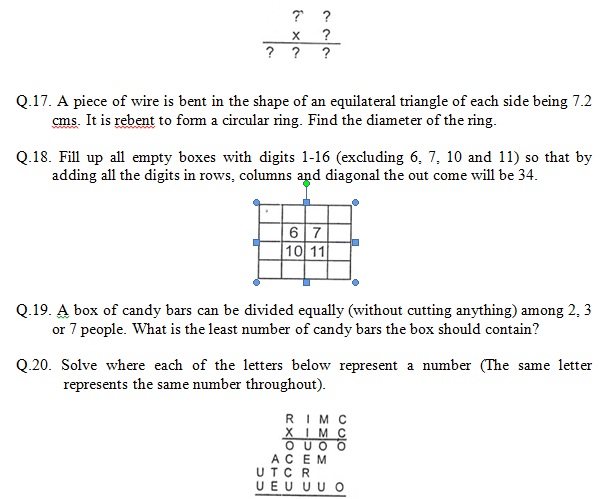
Q.16. Use each of the digits 1, 2, 3, 4, 5 and 6 once only, in this multiplication problem to make it correct.

sainik college

PART 'B' (20 X 5 Marks)


Q.21. Factorize: - (a) 4y2-4yx+ x2-9z2 (b) a2-2ab2+ b2-a + b.


Q.22. A steamer goes down stream from one point to another in 9 hours. It covers the same distance upstream in 10 hours. If the speed of the stream be 1km/hr, find the speed of the steamer in still water and the distance between the ports.


Q.23. The thickness of a metallic tube is 1 cm and the inner diameter of the tube is 12 cm. Find the weight of 1 meter long tube, if the density of the metal be 7.8 gm/cm3.


Q.24. How many sides has a regular polygon, each of whose angle measures 108o?


Q.25. 2 men and 7 boys can do a piece of work in 4 days. The same work is done by 4 men and 4 boys in 3 days. How long would it take 1 man and 1 boy to do the same?


Q.26. A wall 4.84 m long and 3.1 m high is to be covered with rectangular tiles of size 22cm x 10 cm. Find the total cost of the tiles at the rate of Rs. 2 per tile?


Q.27. The pie-chart represents the amount spent on different sports by a school. If the money spent on football is Rs. 9000, answer, the following questions:-
sainik college

(a) What is the total amount spent on sports?

(b) How much extra amount is spent on hockey compared to football?

(c) What is the amount spent on cricket?


Q.28. A cistern can be filled by taps A and B in 10 minutes and 12 minutes respectively. A third tap C can empty this tank completely in 7 minutes. If all the three taps are turned on at the same time find the time taken to fill the cistern?


Q.29. Ram purchased rice worth Rs 500. He sold 3/4th of it at a loss of 10%, and the remainder at a gain of 10%. How much percent does he gain or lose on the whole transaction?


Q.30. In figure triangle PQR and SQR are isosceles. Find the following with reasons:


sainik college